
Lufthansa Boeing 747-830(diecast 1:200, Gemini Jets)
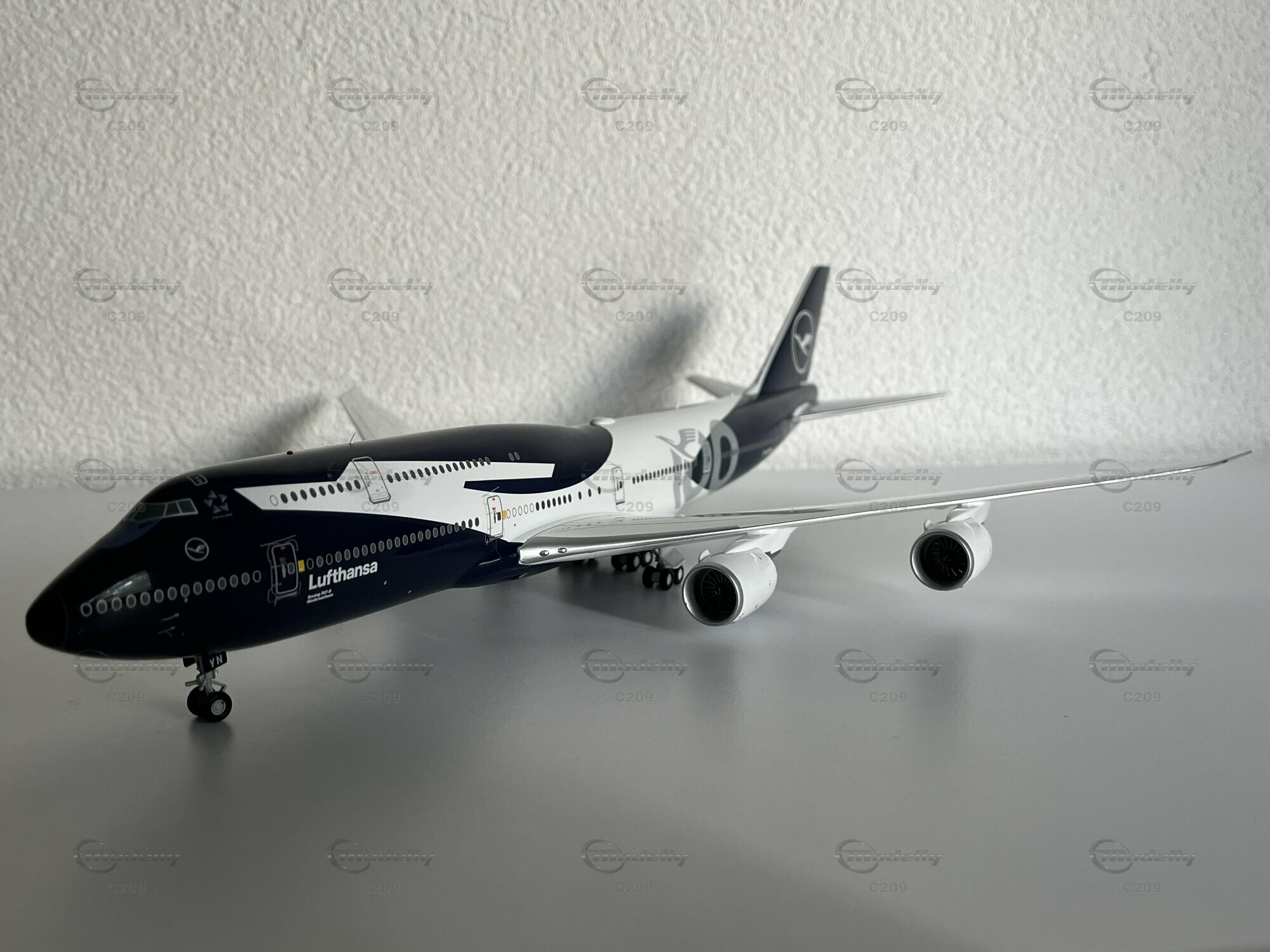
- Boeing 747-830 (from 2014)
- Gemini Jets
- 1:200
- Showcase model / No engine
- diecast
- blue
- Perfect mint condition
- Original packaging exists
- Not for sale
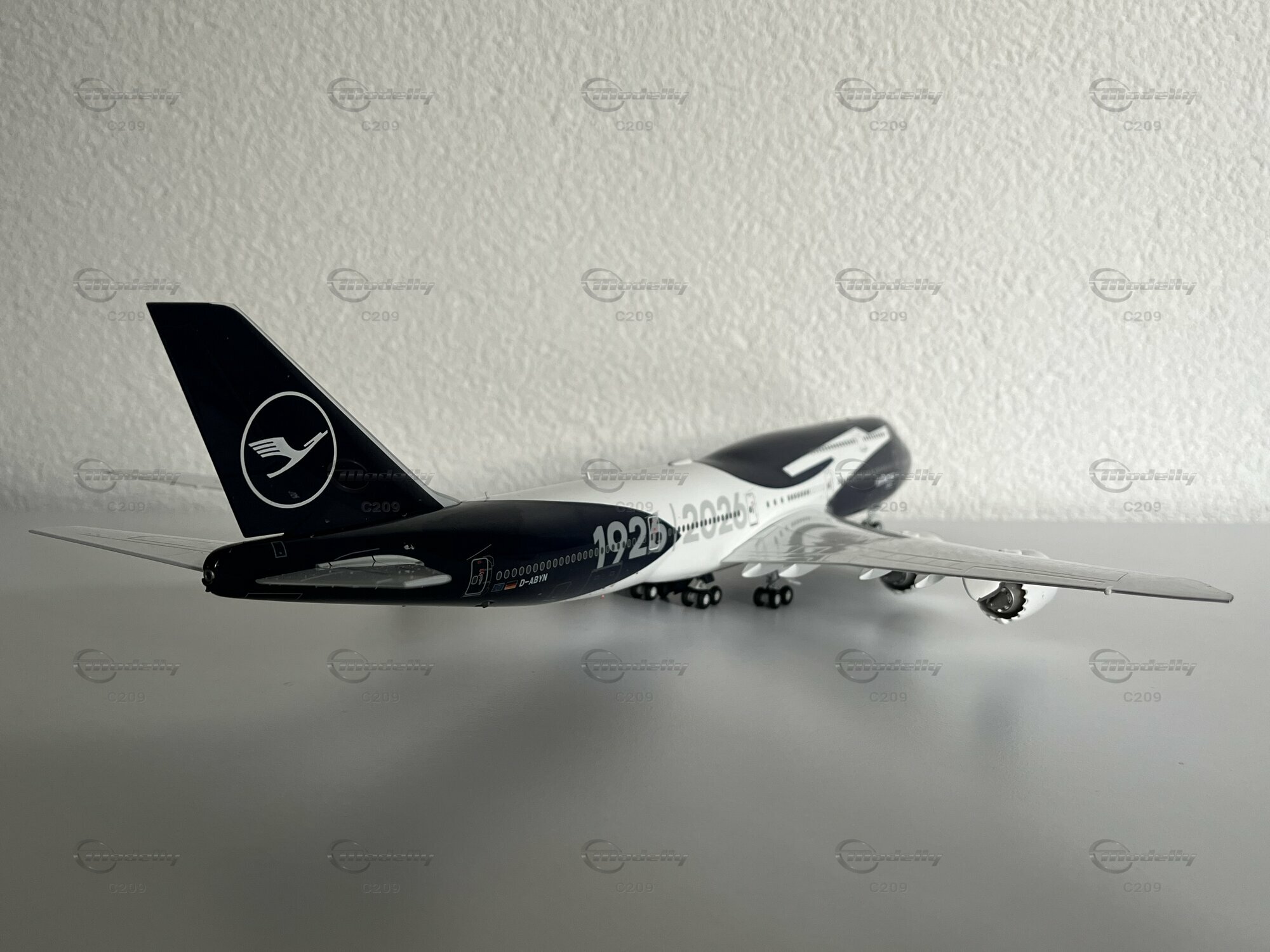
Lufthansa Boeing 747-8 “1926–2026” in 1/200 scale
The model from Modelly member “C209” shows a Lufthansa Boeing 747-830, which belongs to the 747-8 Intercontinental series. The 747-8 is the fourth generation of the Boeing 747 family and was built from 2010 onward; the passenger version, the 747-8I, was delivered starting in 2011. The aircraft shown is clearly registered as D-ABYN. It carries a special livery with the large “1926 | 2026” marking, which points to Lufthansa’s 100th anniversary in 2026. On the dark blue fuselage section, you can see the Lufthansa wordmark, the crane logo in a circle, and the registration D-ABYN. The upper fuselage area and the wings are painted light, while the tail, nose, and lower fuselage section are kept in dark blue. The color split does not follow today’s standard Lufthansa livery, but instead borrows design elements from different Lufthansa eras.
Technical data for the Boeing 747-8 Intercontinental
The Boeing 747-830 is a four-engine long-haul airliner with a continuous main deck and the shortened upper deck that is typical of the 747. Its length is 76.25 meters (250.2 feet), the wingspan is 68.45 meters (224.6 feet), and the height is 19.35 meters (63.5 feet). That makes the 747-8 longer than earlier passenger versions of the 747. Depending on cabin layout, the Boeing 747-830 offers around 410 to 467 seats; Lufthansa used it with a four-class cabin. It is powered by four General Electric GEnx-2B67 engines, each producing about 296 kN (66,534 lbf) of thrust. The cruising speed is Mach 0.855, or about 913 km/h (567 mph), and the maximum speed is about Mach 0.92. With a range of up to around 14,800 kilometers (9,199 miles), the Boeing 747-830 can handle intercontinental routes nonstop. The maximum takeoff weight is about 447,700 kilograms (986,650 pounds). The list price at the time, depending on configuration and contract terms, was around US9 million. In design terms, the 747-8 uses redesigned wings, modern materials in some structural parts, a digital cockpit, and more efficient engines. American aeronautical engineer Joe Sutter led the development of the original Boeing 747, but his design formed the technical basis for the later Boeing 747-830.
Lufthansa, D-ABYN, and the anniversary design
Lufthansa traces its roots back to Deutsche Luft Hansa A.G., which was founded in Berlin on January 6, 1926. The current Deutsche Lufthansa AG began flight operations on April 1, 1955, and still uses the crane as its company symbol. Lufthansa was one of the few airlines to operate the passenger version of the Boeing 747-830: in total, the company received 19 Boeing 747-8 Intercontinentals. D-ABYN was delivered in 2015 and belongs to the Lufthansa 747-8 series with registrations from D-ABYA through D-ABYT. The “1926–2026” livery visible in the photo combines a white fuselage with large dark blue sections. Especially eye-catching are the historic year graphic on the rear fuselage and the large white crane on the dark tail fin. The window rows, doors, emergency exits, and maintenance markings are all part of the design. You can also clearly make out the typical upper-deck contour of the Boeing 747-830, the four engines, and the five-leg main landing gear.
Gemini Jets diecast model for C209’s collection
The collectible shown here is a 1/200-scale miniature made by Gemini Jets. It is produced in diecast, meaning mostly metal, with plastic parts added for details like the engines, antennas, landing gear, and gear doors. The 1/200-scale miniature from Gemini Jets shows the model with the landing gear down; visible are the nose gear with the printed code “YN,” the multiple-wheel main landing gear, and the open gear bays. The engine nacelles have simulated fan blades, while the wings feature flap lines, pylons, position lights, and upward-curved wingtips. On the fuselage, you can see the cockpit windows, cabin windows, cargo and passenger doors, and the Lufthansa branding. For collectors, the special paint scheme is especially important: the year markings, the crane on the tail, and the registration-specific markings clearly identify the model as D-ABYN. The photos show the miniature from both the nose and tail perspectives, documenting the fuselage graphics as well as the design of the tail fin and wings.
- Write a first comment about this model now!Any comment can be discussed by all members. It's like a chat.Mention other Modelly members by using @ in your message. They will then be informed automatically.
- Write a first comment about this model now!Any comment can be discussed by all members. It's like a chat.Mention other Modelly members by using @ in your message. They will then be informed automatically.