
Toyota Supra RZ JZA80(diecast 1:64, Time Micro)
- Toyota Supra RZ JZA80 (from 1993)
- Time Micro
- 1:64
- Showcase model / No engine
- diecast
- orange
- AliExpress
- 35,00 EUR
- In near mint condition
- Original packaging exists
- For sale with fixed price
- 40,00 EUR*
Time Micro Toyota Supra RZ JZA80 in 1/64 from Andy’s collection
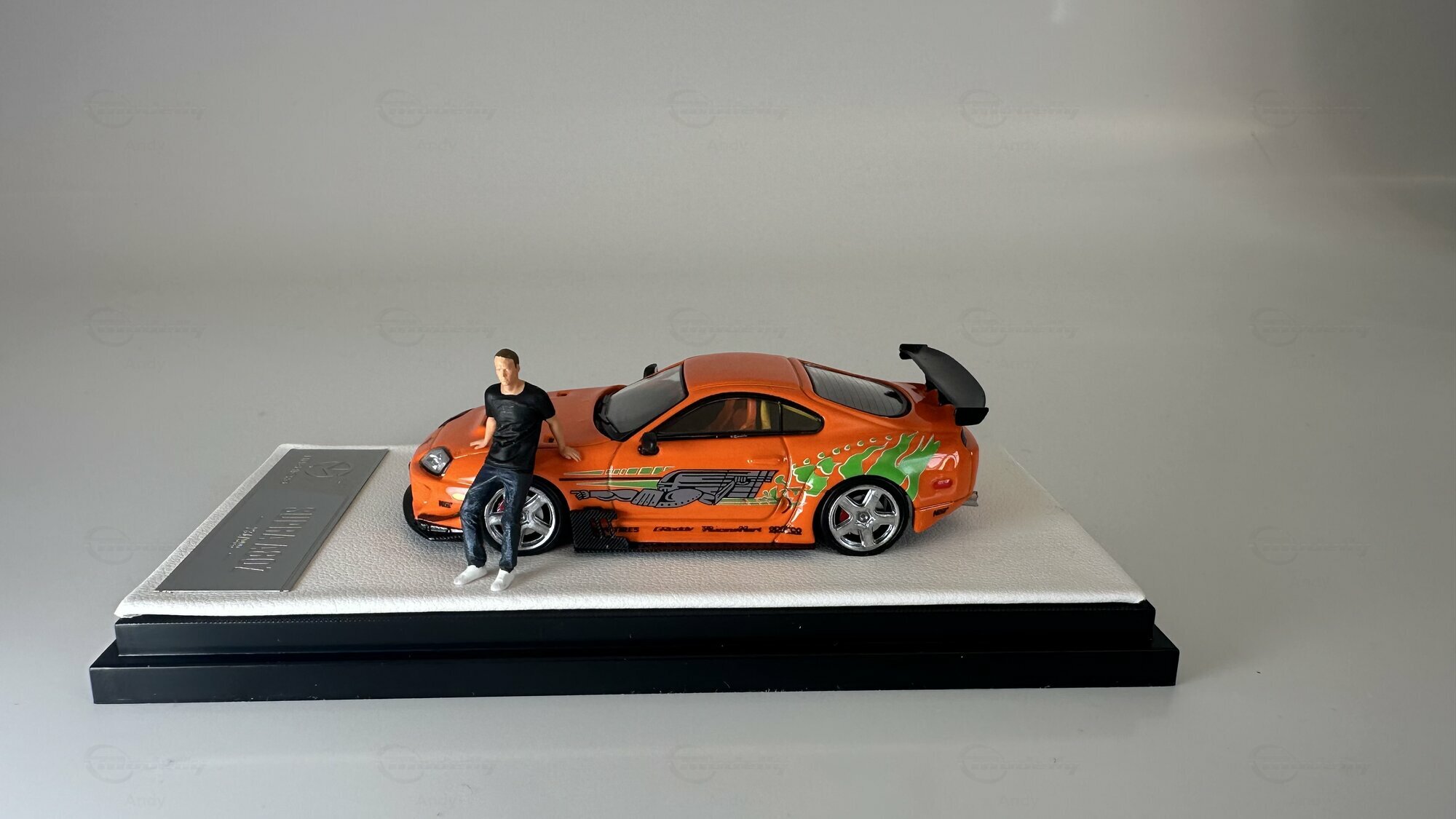
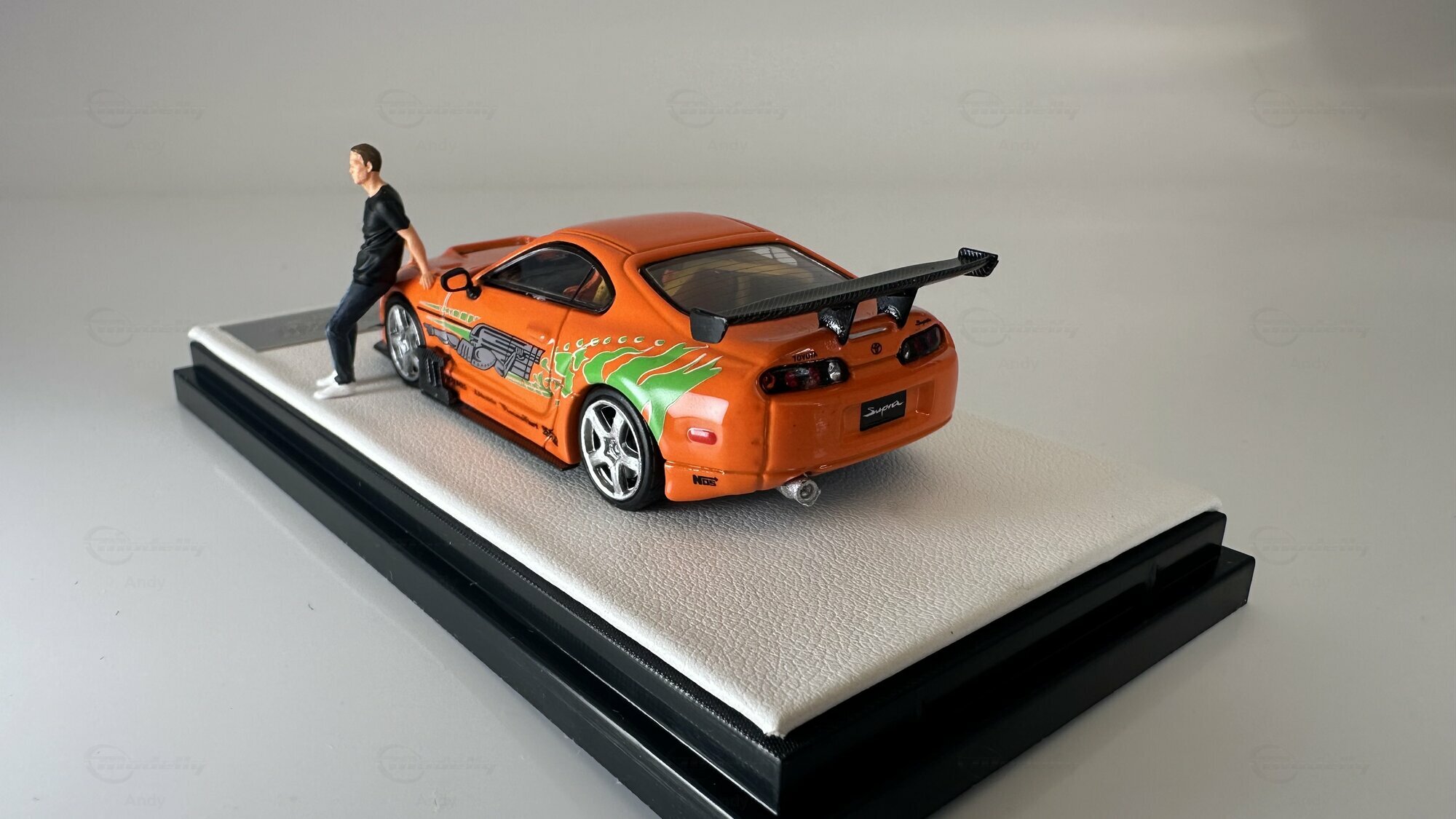
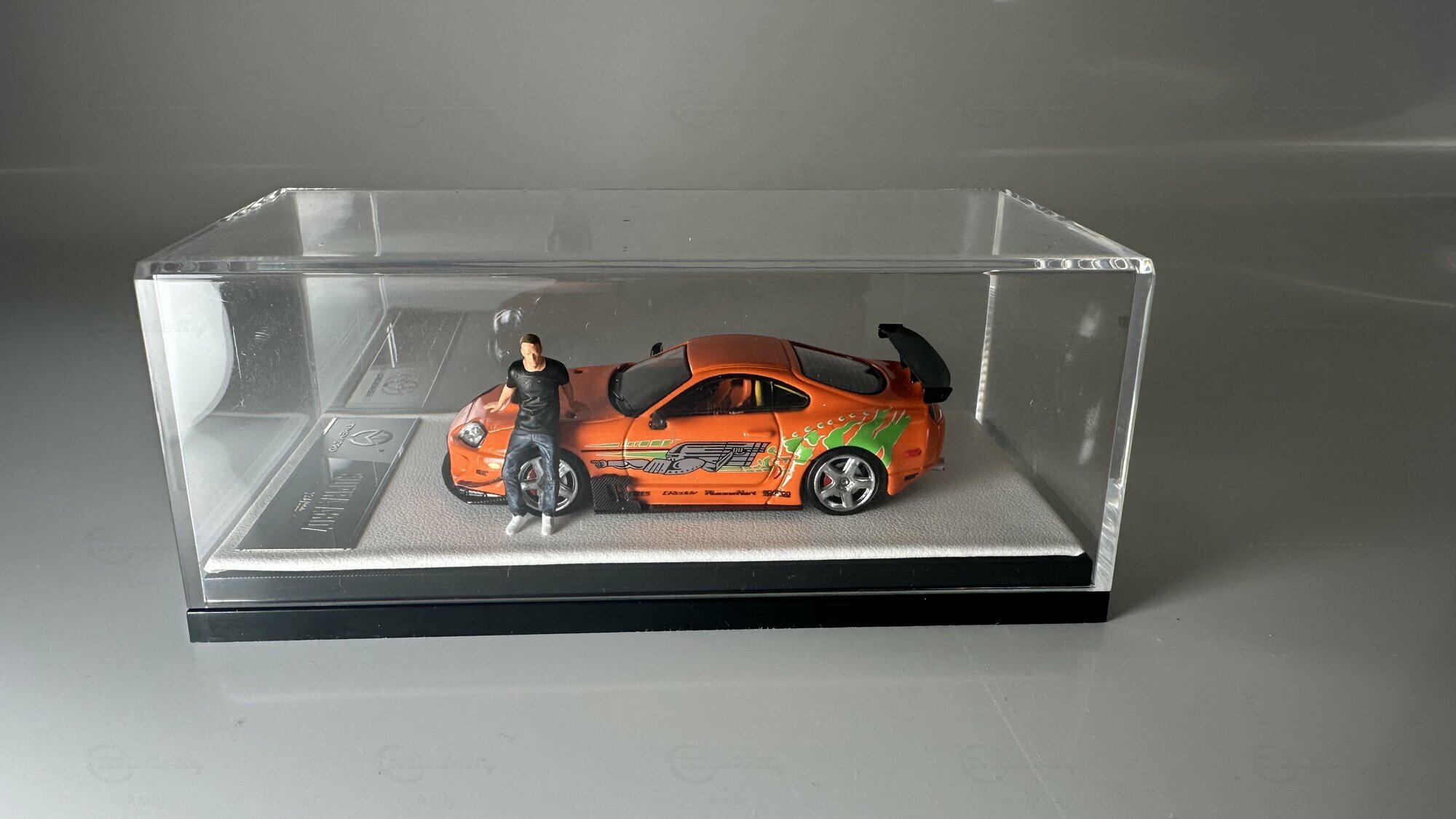
This collector’s piece from Modelly collection owner “Andy” is a model car in 1/64 scale, made by Time Micro. It represents a modified Toyota Supra RZ (JZA80) of the fourth-generation A80, which was built starting in 1993. The miniature sits on a display base with a light textured surface, a black plinth, and a removable clear cover. A figure model is leaning against the driver’s side, which gives the whole thing a little scene-like feel. The model car is made from Diecast and uses a mix of metal body parts and plastic for the windows, spoiler, wheels, and details. For collectors, the limited run matters: Limited Edition – 1 out of 999 pieces worldwide. The side metal plaque and the dust-protective display case are also part of the visible setup. The design of the miniature feels like a complete display piece thanks to the low stance, the large wheels, and the figure, without needing any extra parts.
Technical side of the Toyota Supra RZ JZA80: 2JZ-GTE, rear-wheel drive, and V160
The real car, the Toyota Supra RZ (JZA80), was based on a standalone platform with a front engine and rear-wheel drive. In the Japanese RZ version, it used the 2JZ-GTE, a 3.0-liter inline-six with dual overhead camshafts, 24 valves, and sequential twin-turbo charging. The official Japanese power figure, due to the voluntary manufacturer agreement at the time, was 206 kW or 280 hp; maximum torque was around 431 Nm, depending on the version. A robust six-speed V160 gearbox from Getrag was often used as the manual transmission. Other technical features included independent suspension, disc brakes all around, and an optional Torsen limited-slip differential, plus a streamlined, compact body shape. Its predecessor was the Supra A70 from 1986 to 1992, which was still more closely tied to the Celica line. The A80 was developed under the technical leadership of Isao Tsuzuki, who served as Toyota’s chief engineer for the project. For some time context around the 1993 market launch: that year, the Maastricht Treaty came into force, Bill Clinton became President of the United States, and the movie Jurassic Park hit theaters. These examples help show the technical and cultural backdrop the Toyota Supra RZ (JZA80) came from.
Orange paint with green graphics and visible tuning brands
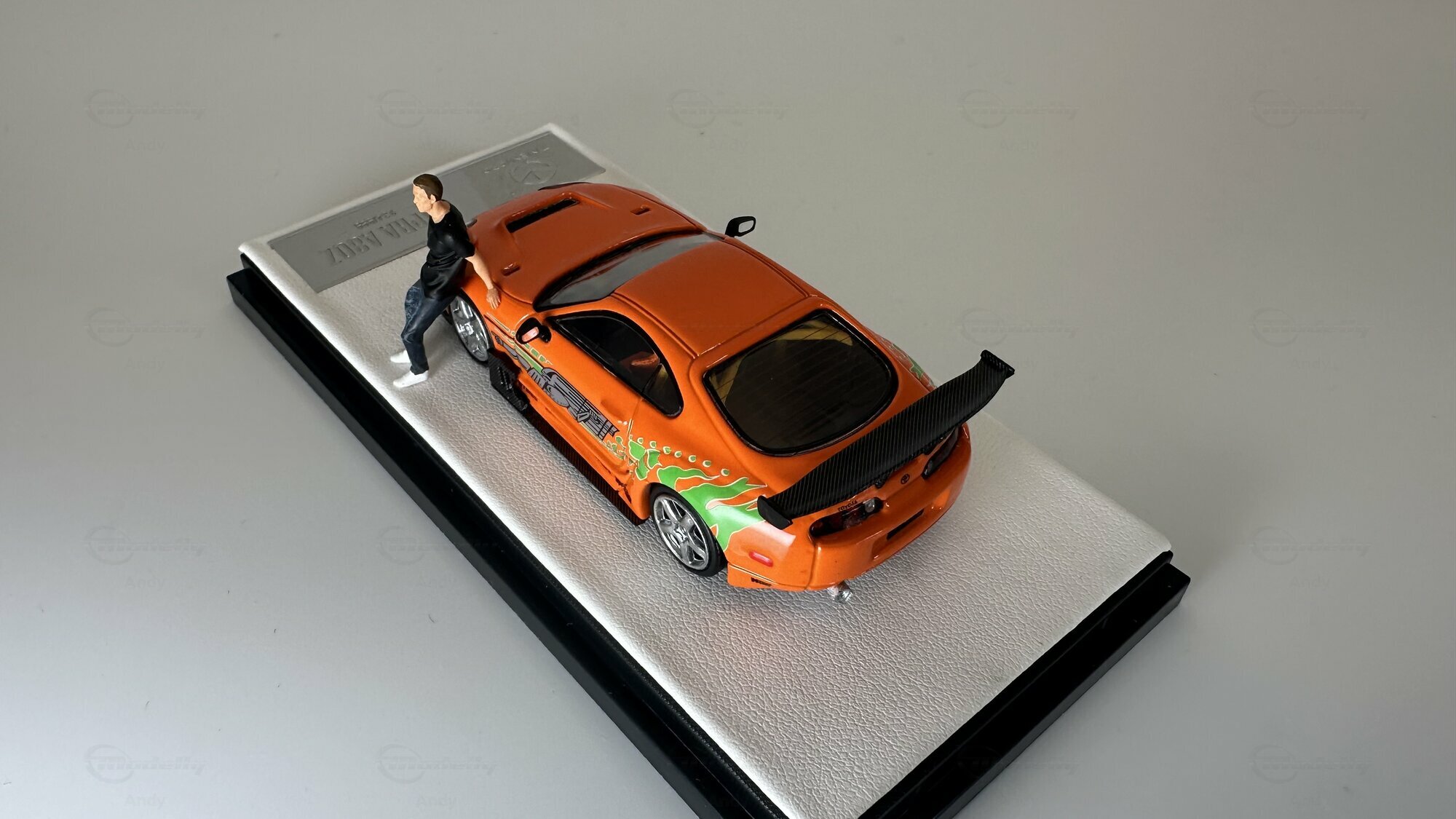
The Time Micro miniature in 1/64 scale uses an orange metallic body color. On both sides, there are multi-part decals: in the door area, there’s a large silver-gray motif shaped like a technical or mechanical illustration. Behind that, green flame-like and stripe graphics with white outlines run toward the rear quarter panel. Along the side skirt, several small sponsor logos are shown. Among them are GReddy and NOS. GReddy is the international brand of the Japanese company Trust, founded in 1977, which makes turbo, intercooler, exhaust, and engine management parts. NOS stands for Nitrous Oxide Systems, a company founded in 1978 in Costa Mesa, California, that specializes in nitrous oxide systems. On this model, these markings are mainly part of the tuning look; from the photos alone, you can’t really tell what actual hardware the depicted car might have. Also noticeable are the large black carbon-look rear wing, the dark side windows, the front spoiler, the side skirts, and the chrome-style five-spoke wheels. The model’s visual appeal comes from the contrast between orange, green, black, and chrome, plus the clearly defined body kit pieces.
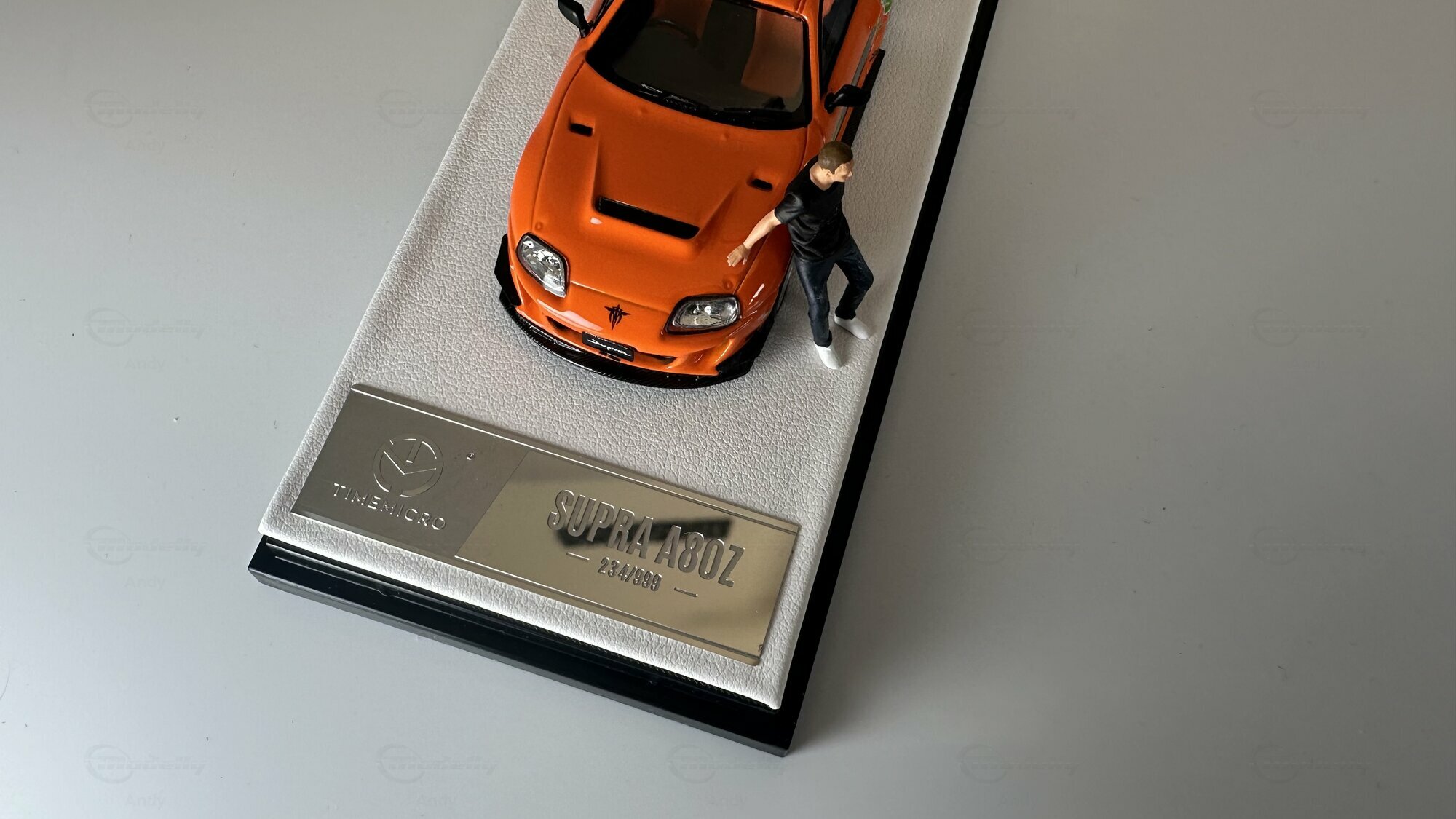
Fast & Furious-inspired Supra scene with Brian O’Conner
The combo of orange base color, green side graphics, large rear wing, tuning decals, and the included standing figure most likely points to the The Fast and the Furious movie from 2001. In that film, a Toyota Supra RZ (JZA80) is built up from a damaged car by Brian O’Conner, played by Paul Walker, together with Dominic Toretto, played by Vin Diesel. Brian is an undercover cop in the story who gets sent into the street-racing scene in Los Angeles; Dominic runs a racing crew and becomes the main focus of his investigation. The orange Toyota Supra RZ (JZA80) appears after the rebuild in the workshop and is driven by Brian in the final drag race against Dom’s Dodge Charger. After the Charger crash, Brian hands Dom the car keys. Andy’s model can therefore be seen as a version inspired by this movie car, even though the photos don’t prove any official licensing. The figure, the side display pose, and the printed license plate with “Supra” lettering add to the clearly recognizable reference in this 1/64 diecast scene.
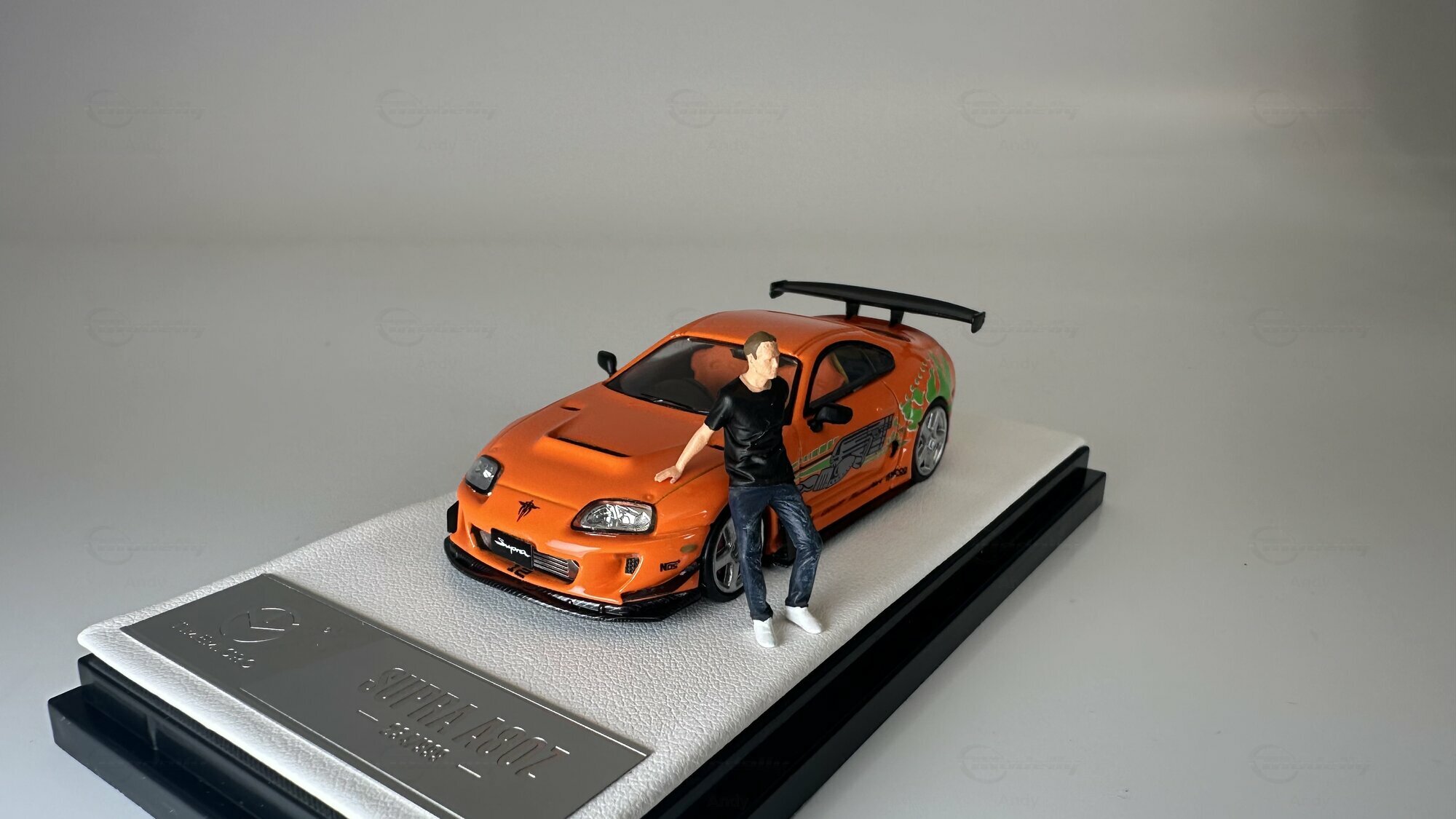
Toyota Supra JZA80: fourth generation and technical basis
The prototype for this miniature is the Toyota Supra RZ JZA80 from the fourth generation (A80), which was built from 1993 to 2002. This generation replaced the Supra A70, which was still more closely linked to the Toyota Soarer and the Celica family. With the A80, the focus shifted to a more independent sports coupe with front-engine, rear-wheel drive layout. In the RZ version, the 2JZ-GTE inline-six worked with 3.0 liters (183.1 cubic inches) of displacement, twin turbochargers, and four valves per cylinder. In Japan, its output was listed as 206 kW (280 PS / 276 hp) because of the old “Gentlemen’s Agreement”; depending on the export market, the official power figure went up to 239 kW (320 PS / 316 hp). The manual gearbox was usually the six-speed Getrag V160, while a four-speed automatic was also available. The technical setup included double wishbone suspension at the front and rear, disc brakes all around, and, on many RZ versions, Toyota’s active TRAC system. Production of the Toyota Supra RZ JZA80 started in 1993; for a bit of time context: that was the year Bill Clinton was sworn in as US president, the Maastricht Treaty came into force, and Wu-Tang Clan released the album “Enter the Wu-Tang (36 Chambers).” These examples help place the car in its historical era.Movie reference: orange Supra from The Fast and the Furious
The look of this model clearly points to the orange Toyota Supra RZ JZA80 from The Fast and the Furious from 2001. The movie is about the illegal street-racing scene in Los Angeles and the investigation into truck hijackings. In the film, the damaged Supra is rebuilt by Brian O’Conner, played by Paul Walker, together with Dominic Toretto’s crew, with Vin Diesel playing Dom. Brian works undercover as a police officer in the racing scene and ends up caught between his assignment and his connection to Dom. Dom leads his own crew and becomes a fugitive after the events involving the hijackings. The Supra is first seen in a race against a Ferrari, later used during the truck chase, and appears again near the end when Dom drives it away. The film cars were built by The Shark Shop, a vehicle shop in California run by Eddie Paul. Documented parts of the movie build include a BOMEX body kit and an APR Performance rear wing. BOMEX is a Japanese manufacturer of aerodynamic parts founded in 1982; APR Performance was founded in California in 1999. The visible decals such as NOS and GReddy are part of the graphics package; by themselves, they do not prove every part that was actually fitted to the film car. NOS was founded in California in 1978, while GReddy belongs to the Japanese Trust group, which was founded in 1977.Time Micro model car in 1/64 scale from Andy’s collection
This exhibit from Modelly member “Andy” is a model car in 1/64 scale, made by Time Micro. The 1/64-scale model car by Time Micro is mounted on a multi-level black display base and is also shown with a clear cover in the photos. The miniature is made of diecast material, with add-on parts like mirrors, rear wing, windows, wheels, and interior details made from other materials as part of the construction. The display platform is covered in a light-colored finish and has a dark plaque with a Supra reference on the left side. Next to the car stands a figure wearing a black T-shirt, dark pants, and light-colored shoes. Its pose, with one hand resting on the body, echoes the movie-style presentation and adds to the small diorama feel. For collectors, the production run is also important: Limited edition – 1 of 999 pieces worldwide. The acrylic cover protects the model, figure, and base from dust, while still letting you see the side graphics and the car’s proportions clearly.Bodywork, paint, and visible details of the 1/64 miniature
The body wears a metallic-looking orange paint finish. Across the doors there’s a large gray-and-black motif in the style of a technical or mechanical illustration. Behind the door, the graphics continue with green and white flame and dragon shapes that stretch over the rear fender. Small sponsor decals run along the side skirts; at the rear, you can spot a NOS logo and a small “Supra” license-plate area. The front shows tinted headlight sections, a deep front bumper, and side add-on parts. The wide rear wing, dark taillight inserts, deep rear bumper, and chrome-looking five-spoke wheels change the stock shape of the Toyota Supra RZ JZA80 toward the film car. A specific wheel brand or exact wheel model can’t be identified for sure from the photos provided. The miniature’s overall effect comes from the contrast between the orange bodywork, green graphics, dark aerodynamic parts, and silver-colored wheels. The side view, rear view, and the presentation under the cover clearly show the paint, decals, and scale.Original and Context: An overview of the fourth Supra generation
The model for this miniature is the Toyota Supra RZ (JZA80), the top version of the series that belongs to the fourth generation and was built from 1993 to 2002. Chief engineer Isao Tsuzuki led the project; the predecessor was the Toyota Supra A70 (third generation, 1986–1993). The Toyota Supra RZ (JZA80) was developed as a sports coupe with a front engine and rear-wheel drive and was positioned above the Celica. For a time reference: the car was already on sale in 1993 — the year the Maastricht Treaty came into force and helped form the EU, Intel introduced the first Pentium Pro processor, and the movie “Jurassic Park” dominated the box office. These examples just give you a feel for the car’s era. The Supra’s body used a lot of aluminum parts (hood, Targa roof on some versions), which reduced weight compared to the predecessor. Aerodynamically it had a drag coefficient (cw) around 0.31, competitive for its class. The suspension uses double wishbones all around, which gives precise handling. In the Japanese nomenclature, the RZ marked the most powerful variant with a bi-turbo engine and a 6-speed Getrag manual gearbox.
Technical specs of the real car and tuning relevance
The Toyota Supra RZ (JZA80) houses the 3.0-liter (0.79 US gallons) inline-six 2JZ‑GTE with sequential twin-turbocharging. In Japan the power was officially listed as 206 kW (280 PS; about 276 hp), internationally it’s often quoted up to 239 kW (320 PS; about 316 hp) and roughly 441 Nm (325 lb-ft) of torque. It was commonly paired with the Getrag 6-speed V160 gearbox, with a 4-speed automatic available as an option. A Torsen limited-slip differential, large disc brakes with four-piston calipers up front, and a precise rack-and-pinion steering are other hallmarks. The drivetrain is famously robust, which made the Toyota Supra RZ (JZA80) a tuning legend — lots of people pushed those engines way past stock power. In the photos you can spot components and brands that have cult status: the body kit name Bomex is closely tied to the movie car; Bomex is a Japanese aero maker founded in the late 1980s. The rear wing resembles parts from APR Performance, which is a California (USA) company founded in 1999. Side sponsor stickers include NOS for nitrous systems. For wheels the car commonly used Racing Hart M5, a multi-spoke rim popular in the US tuning scene. All that explains why the Toyota Supra RZ (JZA80) is today one of the most iconic Japanese sports cars.
The miniature in Andy’s collection: scale, material and details
This model in Andy’s collection shows a Toyota Supra RZ (JZA80) as a 1/64-scale miniature. It was made by Time Micro and is a Diecast casting, which gives it a solid feel and fine engraved details. Important for collectors: it’s a limited edition – 1 of 999 pieces worldwide. The presentation is easy to spot: the Supra sits on a white, leather-like textured base with a black plinth; a clear display hood protects the model. There’s a separate figure leaning on the left front wheel, which livens the scene and highlights the car’s size at this scale. The 1/64 model from Time Micro shows the typical bright orange paint with green‑silver graphics along the flanks. The graphics are reminiscent of the “Nuclear‑Gladiator” motif with stylized arrows and technical symbols. Sponsor names like Bomex, Racing Hart, APR and NOS are finely printed on the sides. Up front you get clear headlight lenses, the rear shows the four tail lamps and a large exhaust pipe. The fixed rear wing in a carbon look and the chrome five-spoke wheels echo the real car; the wheel shape is inspired by the Racing Hart M5. The interior is dark with suggested sport seats. The proportions of the front bumper, side skirts and the Supra roofline are cleanly captured. This miniature is a 1/64-scale model by Time Micro, and collectors will like the mix of movie vibes, precise prints and the clear display. The limited status is also noted on the base: 1 of 999 worldwide.
Movie connection and cultural placement
The look shown here is based on the car from The Fast and the Furious (2001). In that movie the orange Toyota Supra RZ (JZA80) appears in several key scenes: after losing another car, a beaten Supra shell is built up; there’s a scene where it duels a Ferrari on the coastal road, and later the famous train-crossing race and getaway happens. The car is driven by Brian O’Conner, played by Paul Walker; his character is an undercover cop in the illegal street-racing world and ends up torn between loyalties. At the end he hands the car over to Dominic Toretto, played by Vin Diesel, who uses it to escape. The film massively boosted the Toyota Supra RZ (JZA80)’s fame worldwide and turned the combo of Bomex aero, APR Performance wing, Racing Hart M5 rims and NOS stickers into an instantly recognizable look. For context: the real car platform dates back to 1993 — the same year the EU was founded, the first Pentium Pro arrived, and big hits like “I’d Do Anything for Love (But I Won’t Do That)” topped the charts. Those references just help place the car historically. The Time Micro miniature translates those visual cues into 1/64 scale, and the display base, clear cover and included figure make a neat little scene for Andy’s collection.
Miniature at 1/64 scale in Andy's collection – orange JZA80 with a film look
This model is part of Modelly member Andy’s collection and represents a car based on the Toyota Supra RZ JZA80. It’s a 1/64-scale model made by Time Micro. The mini is cast in diecast metal, so the body feels solid and you get nice sharp lines. You can see the orange paint, a big rear wing, chrome-looking five-spoke wheels, and the side graphics with a grey/black mechanical motif plus green flames. There’s a small “NOS” decal on the rear bumper, the front has clear headlight inserts and a detailed grille. The little figure next to the car is placed separately and is leaning on the front area. The model sits on a white display base with a metal nameplate and is protected by a clear display case. Important for collectors: this piece is a limited edition—specifically limited to 999 units worldwide. So it’s a clearly defined collectible for display cases. This 1/64-scale model is from Time Micro and captures a lot of the real car’s details in a compact form.
Technical background on the real thing: fourth generation A80 from 1993–2002
The Toyota Supra RZ JZA80 is the fourth-generation Supra. The A80 was made from 1993–2002. Project lead was Isao Tsuzuki, who’d worked on sporty Toyotas before. Designer input included Kunihiro Uchida. The heart of the RZ is the 3.0‑liter inline-six 2JZ‑GTE (3.0 liters (about 0.79 gallons)) with twin sequential turbochargers. In Japan output was listed under the old gentlemen’s agreement as 206 kW (about 276 hp / 280 PS); export versions could put out up to 239 kW (about 321 hp / 320 PS). It was paired either with a 6‑speed Getrag V160 gearbox or a 4‑speed automatic. A Torsen limited‑slip diff, double‑wishbone suspension all around and big brakes were part of the RZ setup. Kerb weight varied by model around 1,490–1,560 kg (3,285–3,439 pounds), and the drag coefficient was about 0.31. The A80 used a steel body with some aluminum parts (like the hood) for weight distribution. Compared to the previous gen, the Toyota Supra RZ JZA80 had a stiffer structure, improved suspension geometry and a crisper steering ratio. To place the launch year 1993 in context: that was the year the Maastricht Treaty came into force and the European Union formed, Bill Clinton became U.S. president, and Nirvana released “In Utero.” Just some era color for when the Toyota Supra RZ JZA80 was developed and introduced.
Film inspiration, tuning parts and wheels – what you can spot
The model’s graphics clearly reference the car from the movie The Fast and the Furious (2001). In several scenes you see an orange Toyota Supra RZ JZA80: from the garage build to the test drive, the coast sprint vs. a Ferrari, and the final street race. The car’s driven by Brian O’Conner (played by Paul Walker); in the finale Dominic Toretto (played by Vin Diesel) briefly takes the wheel after O’Conner gives him the car. The real movie car used a bunch of tuning parts. The big rear wing is typically an APR Performance piece, while the model’s NOS logo refers to NOS – Nitrous Oxide Systems. The movie car ran 19‑inch multi-piece wheels (that’s about 19 inches / roughly 48.3 cm) — the mini shows a very similar five‑spoke look, so collectors will spot the reference. The side vinyl combines a mechanical grey/black motif with green flames, plus small sponsor logos for that race/street look. The orange paint matches the movie appearance and is reproduced cleanly on the model.
How the model is made, visible details and collector notes
The mini nails the typical diecast crisp edges and fine engraved door seams. Wipers, mirrors and the rear wing structure are separately applied, the headlights are clear inserts with visible projector detail. The taillights are color‑separated and there’s a right‑side exhaust tip under the rear bumper. The body has multi‑color tampo printing: orange base, black technical motif on the sides, green flames and small decals like NOS. There’s a “Supra” badge on the trunk. The model sits on a white textured base with a metal plaque showing the car name. The clear display case keeps dust off but is removable, so it’s easy to display in a 1/64 cabinet. The included standing figure leaning on the front fender is a nice diorama touch that doesn’t hide the car. For collectors the run size matters: this edition is limited to 999 pieces worldwide, so each example is clearly identified. It’s a 1/64 diecast that shows the turbo plumbing, aero parts and the original car’s wheel/tyre proportions in miniature. Overall it’s a solid replica of a well‑known street and movie car that holds a definite spot in Andy’s collection.
- Write a first comment about this model now!Any comment can be discussed by all members. It's like a chat.Mention other Modelly members by using @ in your message. They will then be informed automatically.
- Write a first comment about this model now!Any comment can be discussed by all members. It's like a chat.Mention other Modelly members by using @ in your message. They will then be informed automatically.