
Audi quattro "Urquattro"(1:87, Herpa)
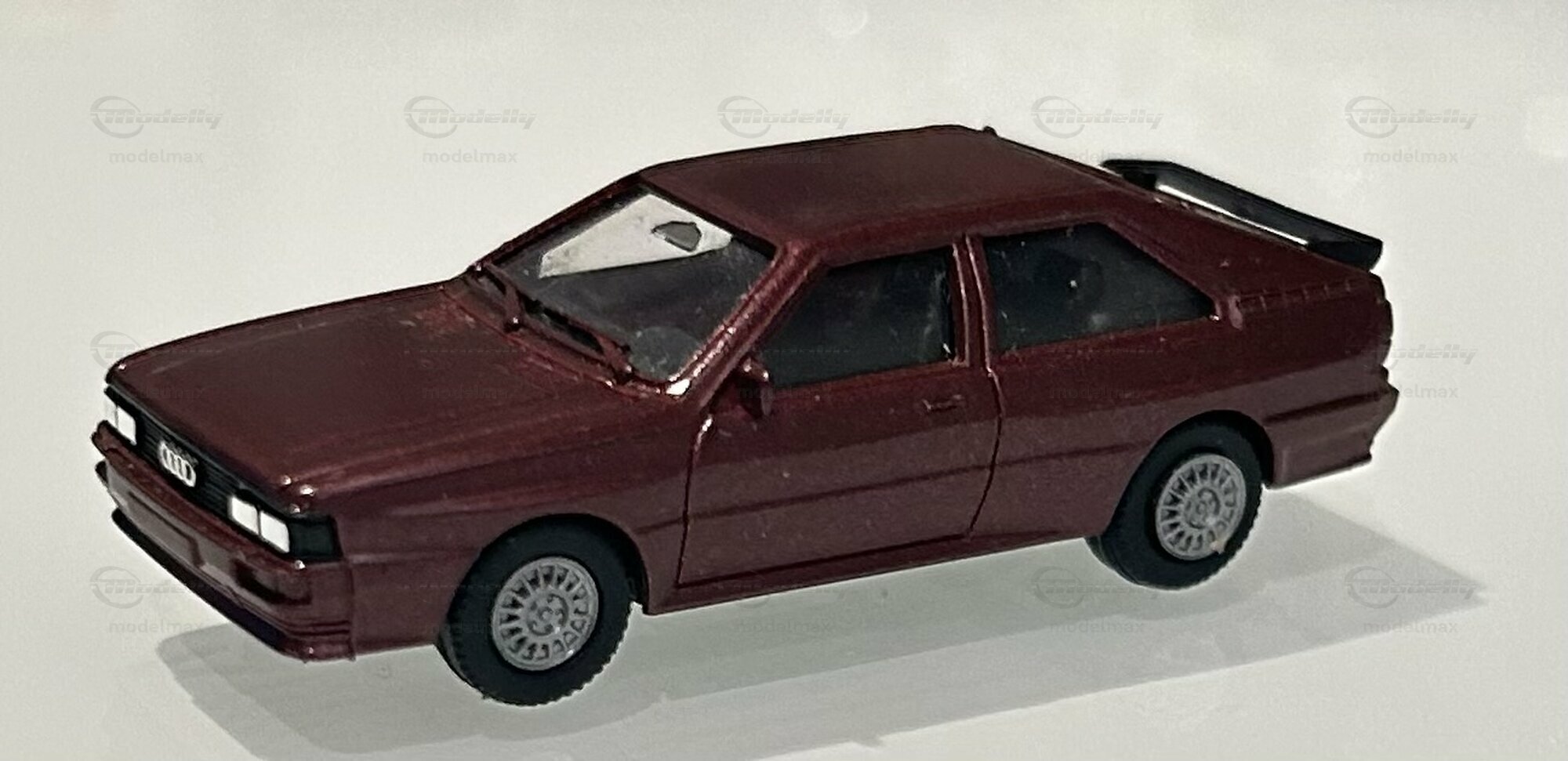
- Audi quattro "Urquattro" (from 1980)
- Herpa
- 1:87
- Showcase model / No engine
- plastic
- others
- In near mint condition
- Original packaging does not exist
- Not for sale
History and context of the Audi quattro (Urquattro)
The real car this model is based on is the Audi quattro, often called the Urquattro. It belongs to the 1st generation and was built from 1980–1991. The series was technically based on the Audi Coupé (type 81/85) and transferred the all-wheel-drive know-how that was tested on the military Volkswagen Iltis into a street coupe. The idea was started by Audi engineer Jörg Bensinger; the project was pushed forward by development chief Ferdinand Piëch, while the production road version was driven forward largely by Walter Treser. The coupe’s design came from Audi’s design team around Martin Smith, with Peter Birtwhistle also involved. With its focus on traction, the Audi quattro dominated the World Rally Championship in the early 1980s and scored wins and titles with drivers like Michele Mouton, Hannu Mikkola and Stig Blomqvist. To put its start year in context: 1980 — the year production began — saw events like the Moscow Summer Olympics (with a big boycott), Pac-Man hitting arcades, and John Lennon being shot — little snapshots that show how old the car is. There wasn’t a direct predecessor; the technical foundation came from the Iltis all-wheel-drive experience applied to a sporty production car.
Technology, generation and specs of the Audi quattro
The Urquattro used a longitudinally mounted, turbocharged — and no, not a V12, but — five-cylinder petrol engine: a 2.1‑liter engine with 147 kW (200 PS / about 197 hp) and 285 Nm of torque. Later it grew to a 2.2‑liter unit with up to 162 kW (220 PS / about 217 hp) and 309 Nm. The 2.1 liters (2.1 L = 0.55 US gallons / 0.46 imperial gallons) and 2.2 liters (2.2 L = 0.58 US gallons / 0.49 imperial gallons) figures are the displacement sizes. Power went through a manual five-speed gearbox to all four wheels. Early cars had manually lockable center (and rear) differentials; from 1987 a Torsen center differential was introduced that distributed torque variably — a big reason the Audi quattro stuck to the road so well on different surfaces. Depending on the version, top speed ranged roughly from about 220–230 km/h (136.7–142.9 mph) and 0–100 km/h times were roughly 7.3 s to about 6.3 s (0–62 mph). Curb weight sat around 1,290–1,350 kg (2,844–2,976 lb). The car got a facelift in 1985 with more slanted/flush headlights, revised bumpers and a tidied-up interior. Signature features — widened fenders, the three-door coupe body and a pronounced rear spoiler — stayed and are echoed in the model you’ve got. The suspension used MacPherson struts up front and a multi-link/compound rear axle; combined with ventilated front discs (and rear discs or drums depending on year) those systems made the car sportier but still usable every day.
The Herpa 1/87 model shown in modelly member “modelmax”
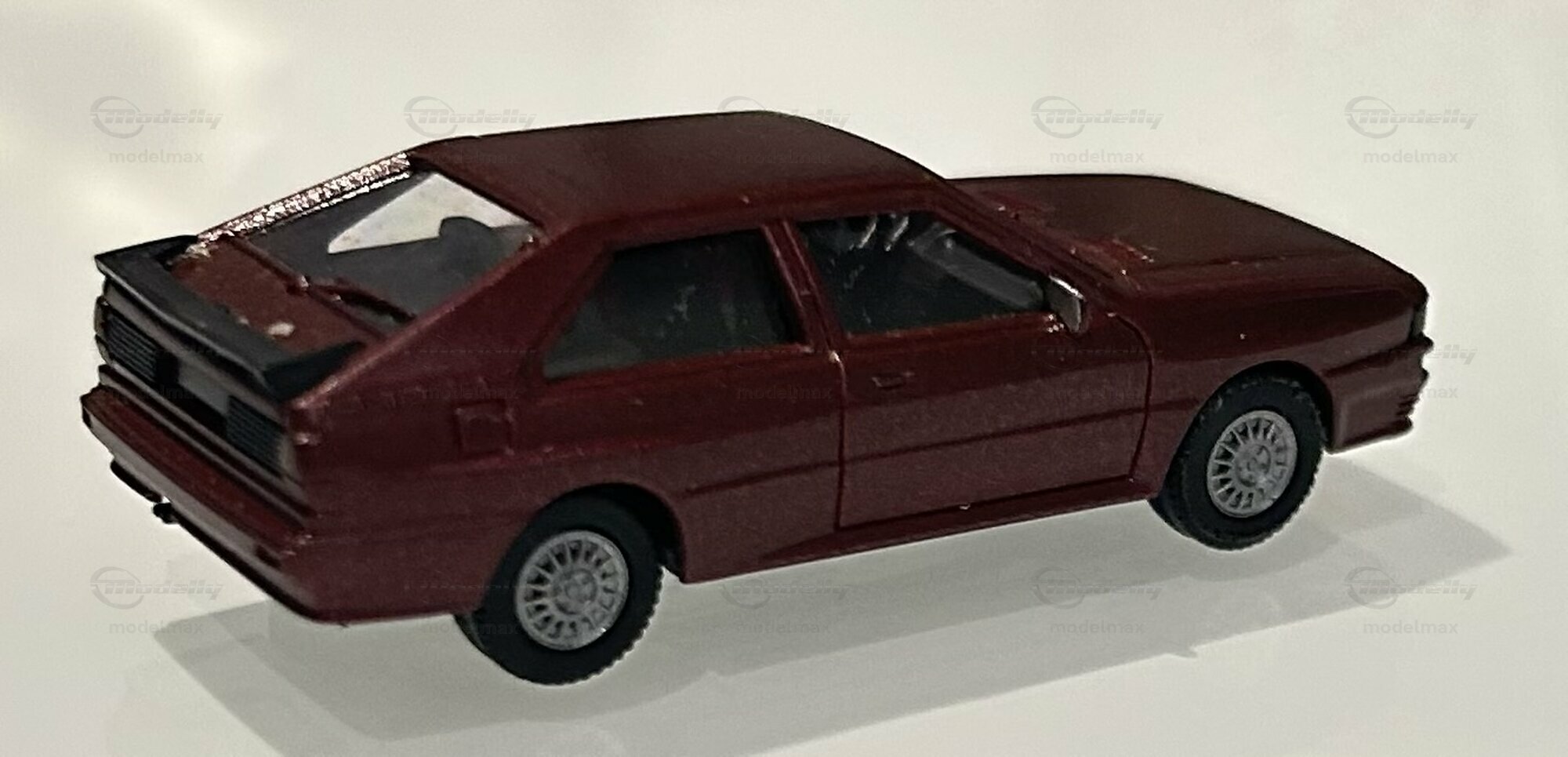
The photos show a 1/87 scale model from Herpa that’s modeled on the Audi quattro and is part of modelly member “modelmax”’s collection. The miniature is plastic; the body is injection-molded plastic, so it’s lightweight and nicely to scale. The paint looks like a dark wine red with a bit of metallic shimmer; contrasts come from the black front spoiler, black window trims and the black rear wing. The grille with the four rings is represented on the front, the rectangular headlights are separately shown and emphasize the car’s angular front end. The side profile shows the car’s characteristic wide wheel arches and the clear beltline of the coupe. The rear end with the broad spoiler and the sloping rear window is faithfully reproduced. The wheels have a fine multi-spoke look; I can’t identify a specific wheel brand from the model, but they resemble period alloy wheels. The interior is dark; you can see seats and a steering wheel through the windows. Overall the model’s proportions match the Urquattro well, without going overboard on tiny details. For collectors it’s obvious the doors, hood and trunk don’t open — which keeps the lines clean. Surface transitions between bumpers and side skirts are clear, and panel gaps are indicated by fine engraved lines. This 1/87 Herpa model shows a standard road-going version; there are no race decals or tuner markings visible, so it’s not tied to any team or movie/show livery.
Time frame, collector notes and paint details
To place the Audi quattro in time: remember its start year, 1980 — a year that also saw the rise of the Polish Solidarity movement led by Lech Wałęsa, the Mount St. Helens eruption in the US, and AC/DC releasing “Back in Black.” Those sorts of references help you get a feel for the era. The model here shows the typical sharp lines of the early years with pronounced fender flares and the rearward-sloping roof. The wine-red paint is applied evenly and has a calm gloss that keeps the edges readable. The black rear spoiler is a strong contrast and points straight to the aerodynamics detail of the Urquattro. Because there are no obvious wheel-brand marks, I’m not calling out a manufacturer. For display the 1/87 size is convenient — it takes little space but is instantly recognizable thanks to the silhouette. Collectors will also note the era-typical rectangular lights and the understated bumpers. The miniature is made from plastic, which gives it smooth surfaces and low weight. If you’re building a collection that shows the evolution of the model line, the Audi quattro offers several onscreen and mechanical eras within its 1st generation (1980–1991). This Herpa 1/87 piece focuses on the car’s clear basic shape and is a solid add to “modelmax”’s display.
- Write a first comment about this model now!Any comment can be discussed by all members. It's like a chat.Mention other Modelly members by using @ in your message. They will then be informed automatically.
- Write a first comment about this model now!Any comment can be discussed by all members. It's like a chat.Mention other Modelly members by using @ in your message. They will then be informed automatically.