
Porsche 917 4.9 Kurzheck 24h Le Mans 1971(diecast 1:64, Hot Wheels Premium Real Riders)
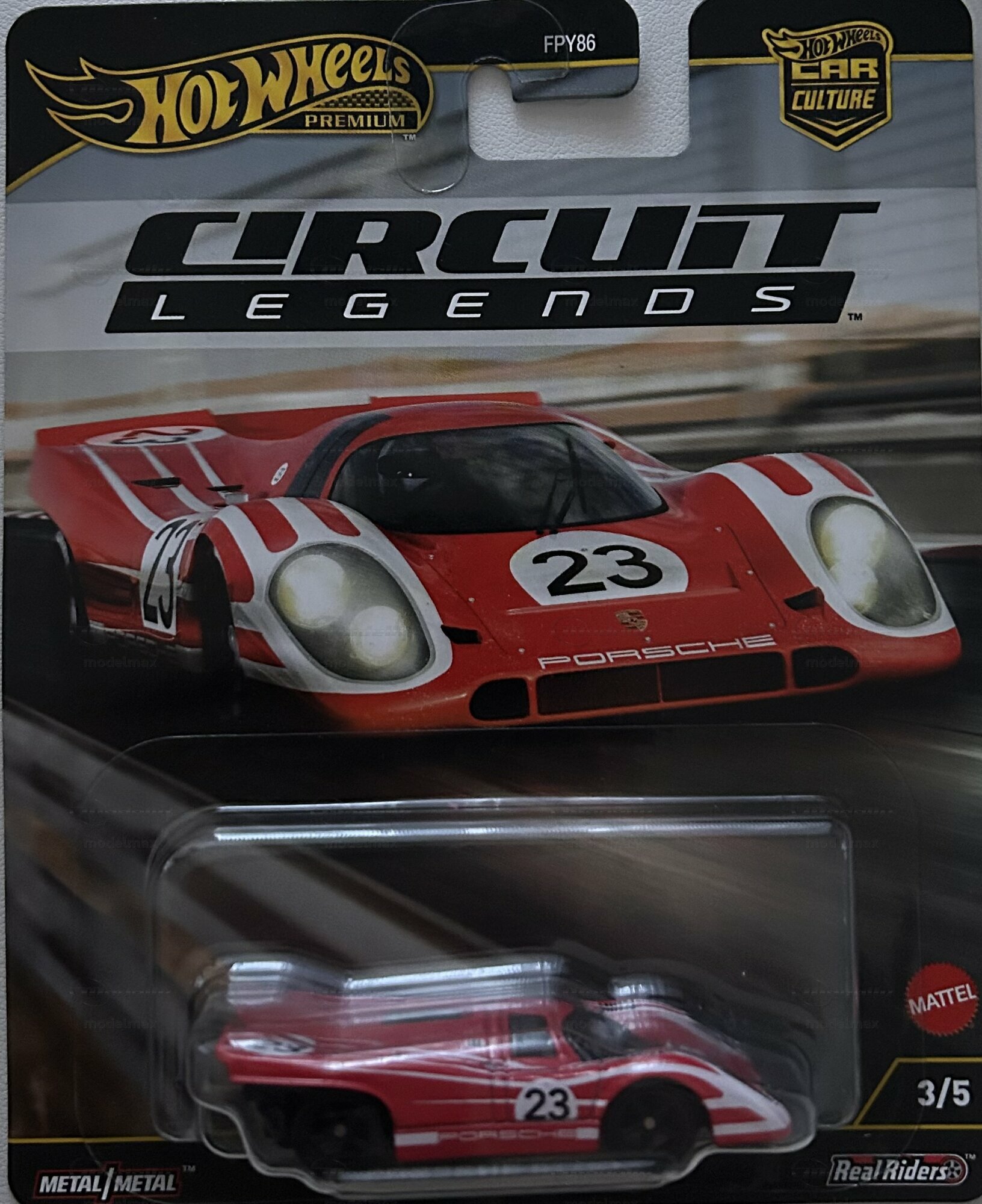
- Porsche 917 4.9 Kurzheck 24h Le Mans 1971 (from 1971)
- Hot Wheels Premium Real Riders
- 1:64
- Showcase model / No engine
- diecast
- red
- online dealer
- Perfect mint condition
- Original packaging exists
- Not for sale
Hot Wheels Car Culture Circuit Legends: Porsche 917 in collector format
The collectible shown here from Modelly member “modelmax” is a model car in 1/64 scale, made by Hot Wheels Premium Real Riders. The card says it’s from the “Circuit Legends” series, and it also features the premium details “Metal/Metal” and “Real Riders.” You can also see that it is number 3/5 in the set. The diecast model is built as a diecast piece and shows a race car with clear references to the Porsche 917 4.9 Kurzheck, as it was used in long-distance racing in the early 1970s. The packaging artwork shows the same car in red with white sections over the fenders and the race number 23. The actual model in the blister uses that same design in miniature form. Also visible are black wheels with rubber tires, a low and long body, the closed cockpit canopy, and the large rear section. For collectors of 1/64 race cars, it’s interesting that the card clearly shows the Porsche name on the front illustration, which helps confirm the historical reference.
Porsche 917 Kurzheck prototype: generation, development, and tech
The prototype behind this is very likely the Porsche 917 4.9 Kurzheck, a model from the 917, 1st generation, built from 1969. The 917 was Porsche’s answer to the FIA rules at the time, which required a small production run for Group 4 sports car homologation. Earlier cars in Porsche’s broader racing story included the 908 and its further developments, which had already given the company valuable experience with lightweight tube frames, aerodynamic tuning, and endurance racing use. Key people involved in the 917’s development included Ferdinand Piëch on the engineering side and Hans Mezger on the engine side; for body and aerodynamics, several engineers worked closely together, including Helmuth Bott. A defining feature of the 917 was its air-cooled rear-mounted flat-12 engine, a lightweight spaceframe made of aluminum tubing, plastic body panels, and an overall very low car concept. The Kurzheck version was built for tracks that needed more downforce and more stable handling than the early long-tail versions. In the 4.9-liter setup, the engine made well over 500 hp depending on tune, paired with a manual 5-speed gearbox. The car was designed for high top speeds, but also with a strong focus on weight reduction, quick race servicing, and aerodynamic efficiency.
Motorsport wins of the Porsche 917 and well-known drivers
The Porsche 917 4.9 Kurzheck is one of the cars that really defines the era when Porsche became a regular overall winner at the big endurance classics. Most famously, it won Le Mans in 1970, giving Porsche its first overall victory at the 24 Hours of Le Mans. It stayed highly competitive in 1971 too. The 917 family wasn’t just fast in a straight line; after serious development work, it also got much better in high-speed stability and tire management. The Kurzheck versions in particular turned out to be more practical than the early long-tail designs on many tracks. Well-known drivers of this car family included Pedro Rodríguez, Jo Siffert, Derek Bell, Richard Attwood, Hans Herrmann, Vic Elford, and Gijs van Lennep. Their races helped build the 917’s legendary reputation.
Beyond Le Mans, the Porsche 917 4.9 Kurzheck also scored major results in the Sports Car World Championship. In the 1970 season, Porsche won several key races with the 917 and secured the manufacturers’ world title. The technical range of the family also showed up later in the 917/10 and 917/30 versions for the Can-Am series, even though those were already separate evolution steps. Drivers like Pedro Rodríguez and Leo Kinnunen were especially linked to the Gulf 917s, while other factory and customer teams used different paint schemes and setups. The red racing livery shown on this miniature with number 23 brings to mind a Le Mans context from the early 1970s. Visible sponsor decals are only limited on the model itself; the clearest readable marking is the word “Porsche.” Other classic sponsor brands like Martini or Gulf are not visible on this example, so the exact race version can’t be pinned down just from the photo alone.
Paint, shape, and details of the 1/64 miniature
The paint scheme on the miniature is done in red and white. The main body color is red, with white, flowing sections over the front fenders and along the sides. On the hood and doors, the race number 23 appears in black on a white circle or white panel. The side carries a white “PORSCHE” logo. This layout captures the typical look of early endurance prototypes: strong contrasts, easy-to-read number panels, and a stripped-down set of extra markings. The shape of the miniature does a good job of reflecting the 917’s low profile, with a long front end, a low roof arc, pronounced wheel arches, and the signature rear section. From a collector’s point of view, the proportions of the original are translated quite well into 1/64: short front overhang, wide track, and a cockpit that looks compact. This model car in 1/64 scale, made by Hot Wheels Premium Real Riders, uses rubber tires and a metal body, which are two of the main premium features in this series. The beauty of the model is mostly in how honestly it represents the racing shape, the low lines, the cleanly separated color areas, and the calm, historical overall look on the card and in the blister.
Collector’s take on the card, series, and modelmax version
For collectors, the place within the Car Culture lineup matters: “Circuit Legends” is printed in a large font on the card, “Hot Wheels Premium” sits at the top left, and the “Car Culture” logo is at the top right. At the bottom, “Metal/Metal” and “Real Riders” are listed, and the set number 3/5 appears on the right. The item code FPY86 is visible near the top of the card. All of that makes this miniature in “modelmax”’s collection easy to identify. The blister shows the vehicle in side view, which makes the race number, side line, and wheelbase easy to see. The wheels look black and don’t have any flashy trim rings, which fits a race car from that era. The transparent cockpit cover is shown in a dark tint, which supports the closed prototype character. Based on the photo, the build looks clean; the tampo printing is visible on the front and sides, and the card artwork adds a dynamic view of the real car. For searches around Hot Wheels Porsche 917, Car Culture Circuit Legends, Le Mans 1971, and premium 1/64 models, this piece gives a very clear theme match without relying on made-up naming.
- Write a first comment about this model now!Any comment can be discussed by all members. It's like a chat.Mention other Modelly members by using @ in your message. They will then be informed automatically.
- Write a first comment about this model now!Any comment can be discussed by all members. It's like a chat.Mention other Modelly members by using @ in your message. They will then be informed automatically.