
Porsche 911 Turbo(diecast 1:43, Norev)
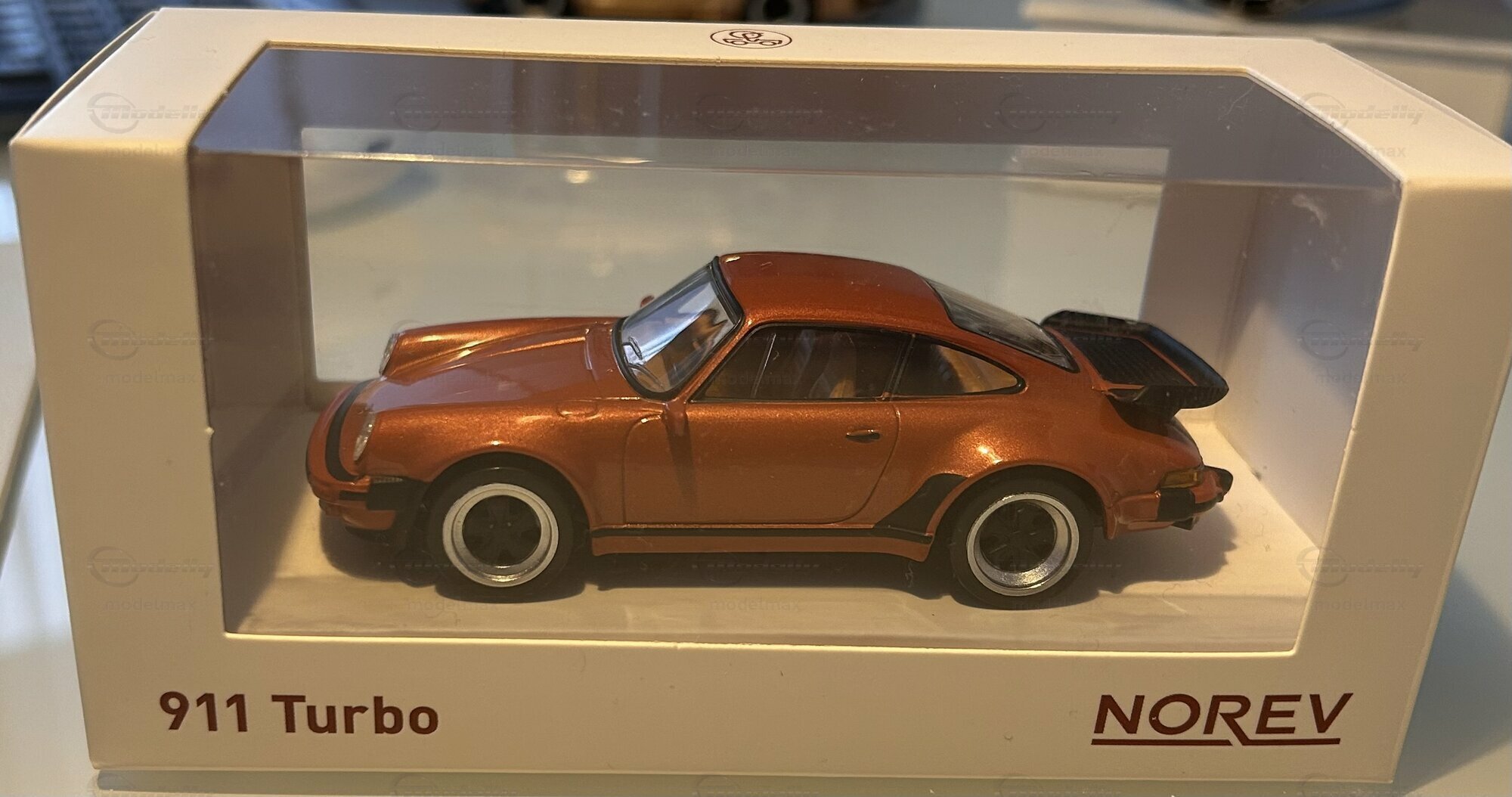
- Porsche 911 Turbo (from 1975)
- Norev
- 1:43
- Showcase model / No engine
- diecast
- Kupfer Met.
- locale dealer
- Perfect mint condition
- Original packaging exists
- Not for sale
History and context of the real car: The Porsche 911 Turbo 930
The real car this model is based on is the Porsche 911 Turbo from the 930 generation, built from 1975–1989. The Porsche 911 Turbo kicked off Porsche’s run of turbocharged 911s for the road and started the brand’s street‑Turbo era. Stylistically it’s rooted in the original 911 drawn by Ferdinand Alexander Porsche. The production turbo project was pushed forward largely by Ernst Fuhrmann; the engine and racing tech owes a lot to Hans Mezger. The racing 911 Carrera RSR 2.1 Turbo laid the technical groundwork; the closest predecessor in the road lineup was the 911 Carrera 2.7/3.0 without a turbo. To place it in time: the Porsche 911 Turbo first appeared in 1975, the same year the Vietnam War ended with the fall of Saigon, Microsoft was founded, and the movie “Jaws” hit cinemas. I’m just throwing those in to give you a feel for the era when the 930 showed up.
Technical data and quirks of the original
The Porsche 911 Turbo launched in 1975 with a 3.0‑liter flat‑six boxer engine with an exhaust turbocharger from Kühnle, Kopp & Kausch (KKK) — that’s 3.0 liters (about 183 cubic inches). It made roughly 191 kW (about 257 hp / 260 PS) and around 343 Nm (about 253 lb‑ft) of torque. In 1978 the displacement was bumped to 3.3 liters (about 201 cubic inches) and an intercooler was added. Power then climbed to roughly 221 kW (about 296 hp / 300 PS), and top speed was around 260 km/h (about 162 mph). The car was rear‑wheel drive, originally had a four‑speed manual (later, from model year 1989, a five‑speed G50/50 box), and mechanical K‑Jetronic fuel injection. Brakes were ventilated discs all around; the famous “whale tail” rear spoiler helped cooling and downforce (on the 3.3‑liter cars it also made room for the intercooler). The suspension used torsion bars front and rear, with anti‑roll bars and relatively stiff dampers. Wide fender flares made room for bigger wheels; the classic Fuchs wheels are often pictured on these cars. Dimensions and weights: length about 4.29 m (about 14.07 ft / 169.0 in), wheelbase 2.27 m (about 7.45 ft / 89.4 in), curb weight depending on year roughly 1,250–1,350 kg (about 2,756–2,976 lb). Those specs helped the 930 hit roughly 0–100 km/h (0–62 mph) in about 5.5–6.0 s and cemented its reputation as a very fast road car in the late ’70s and ’80s.
The collectible model from Norev: 1/43 diecast in the modelmax collection
The miniature shown belongs to collector “modelmax” and represents the Porsche 911 Turbo in the common display scale 1/43. It’s a diecast body, which gives a nice solid feel and good surface finish. The photos show a copper‑brown metallic paint that looks like period Porsche colors (think “Copper Brown Metallic”). The metallic flakes and gloss bring out the 930’s lines: the rounded front fenders, the pronounced rear haunches and the black “whale tail” spoiler. Front and rear bumpers have black rubber trims like the real deal. The wheels mimic the Fuchs look with a black center and polished rim — a signature 930 touch. Behind the clear windows you can spot a dark‑brown interior with front seats, a rear bench and a dashboard. Overall the scale looks consistent: short overhangs, a low hood, the gently sloping roof and the steep rear deck. The model comes in a white display box with a clear window; the base is labelled “911 Turbo” and the maker Norev is printed on it.
Details, paint and collector notes
For collectors it’s worth noting this model depicts the stock Porsche 911 Turbo, no aftermarket tweaks or movie liveries. Nothing obvious ties this specific miniature to a film or TV appearance, so there’s no media association to call out. The lighting elements keep to the round headlights up front and the compact rear lights; badges and script are understated and faithful to the original. The paint coverage looks even, so door gaps, window surrounds and wheel arches are nicely readable. The standout combo here is the copper‑brown paint, black rear wing and the two‑tone Fuchs‑style wheels — a look that’s typical of many late‑’70s 930s. Diecast is a practical choice for collectors because it gives good part fit and makes the model stable in a display. One more scale note: it’s a 1/43 model by Norev, so it fits right into standard 1/43 collections and dioramas. If you want more context for the car’s era: 1975 also saw Queen release “Bohemian Rhapsody” and the Viking 1 spacecraft prepping for its Mars mission — just more ways to picture the time when the 930 arrived. All in all, the mini from modelmax captures the 930’s silhouette, wide flares and functional whale tail pretty faithfully, giving a straightforward, scale‑accurate take on this classic sports car.
- Write a first comment about this model now!Any comment can be discussed by all members. It's like a chat.Mention other Modelly members by using @ in your message. They will then be informed automatically.
- Write a first comment about this model now!Any comment can be discussed by all members. It's like a chat.Mention other Modelly members by using @ in your message. They will then be informed automatically.