
Porsche 911 (997) GT3 Cup(diecast 1:18, Welly)
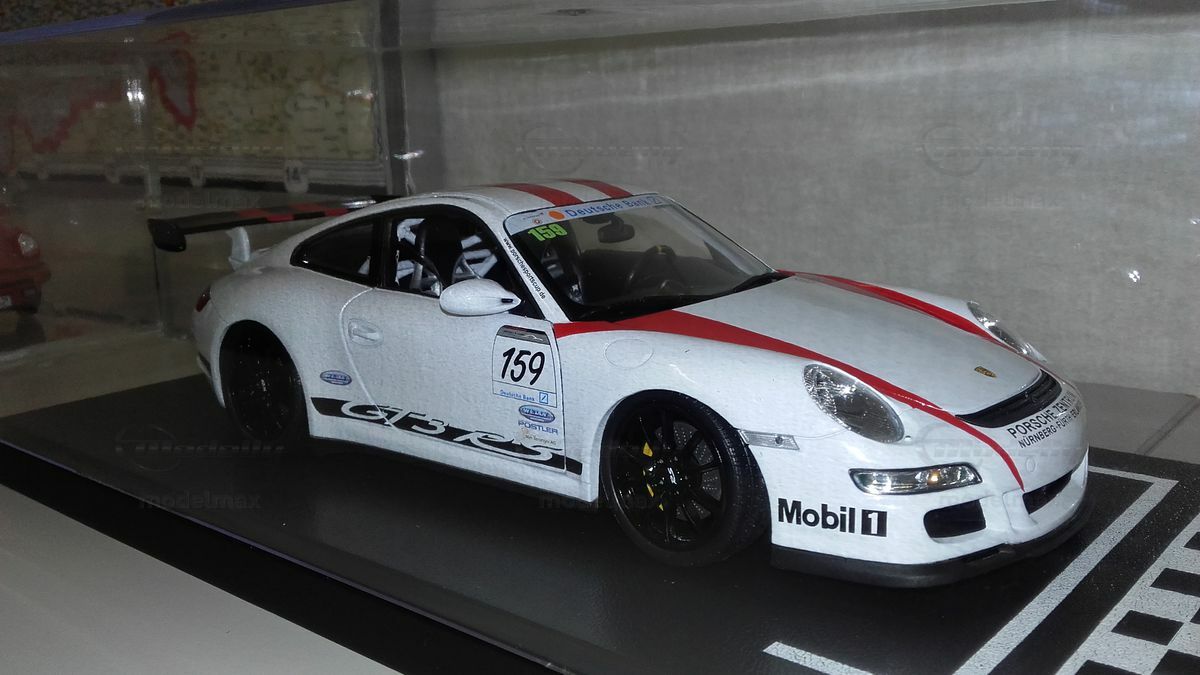
- Porsche 911 (997) GT3 Cup (from 2012)
- Welly
- 1:18
- Showcase model / No engine
- diecast
- white
- Not specified
- Not specified
- Not for sale

Model: Porsche 911 of the 997 generation and its GT3 Cup derivative
This model is based on the race car Porsche 911 (997) GT3 Cup, a customer-racing version of the 911 that’s close to factory spec. The 997 generation was built from 2004–2012 and took the 996’s basics but brought back more classic-looking headlamps and revised chassis kinematics. The production design language was handled in the design department by Michael Mauer, while the GT derivatives including the Cup cars were developed in Weissach under the GT program led by Andreas Preuninger. The Porsche 911 (997) GT3 Cup was based technically on the road-going GT3 and adopted elements like the water-cooled six-cylinder boxer engine, a torsion‑stiff safety cell and a stripped-down body with no unnecessary comfort kit. Its predecessor is the 996 GT3 Cup, which had already been active in one-make cups and laid the technical groundwork for the 997 series.
Technical bits and specs of the original Cup Porsche
The Porsche 911 (997) GT3 Cup first appeared with a 3.6‑liter boxer (219.7 cubic inches) putting out about 309 kW (420 PS). Later, in the updated late 997 models the displacement grew to 3.8 liters (231.9 cubic inches) and power rose to around 331 kW (450 PS). Drive was via a sequential six-speed gearbox with pneumatic shifting, built for precise changes under racing load. The brake setup used vented and drilled steel discs, rigid four‑piston calipers and an adjustable brake bias. The suspension featured McPherson struts up front and a multi-link rear with uniball joints, camber adjustment and adjustable anti-roll bars. An engine management system with data logging let teams read out parameters like lambda, oil temperature and suspension travel. Weight savings from lightweight panels, reduced insulation and some carbon-fiber parts brought the dry weight down to roughly 1,200 kg (2,645.5 pounds), giving the Porsche 911 (997) GT3 Cup a very favorable power-to-weight ratio. Aerodynamics were improved with a lower front splitter, side airblades and an adjustable rear wing to generate downforce for both sprint and endurance formats.
Successes in customer racing and notable drivers
The Porsche 911 (997) GT3 Cup has a long track record in one-make cups. In the Carrera Cup and the Mobil 1 Supercup the Cup 911 was the standard car for many years. Drivers who notched a lot of wins in that car include René Rast, Jeroen Bleekemolen, Patrick Huisman and Sean Edwards. Their results in high-level sprint series helped make the 997 famous. Also in endurance racing, for example in the VLN at the Nürburgring, the Porsche 911 (997) GT3 Cup repeatedly set the benchmark in its class. The robust basic layout, fast pit stops thanks to a dry‑sump clutch and the reliable thermal characteristics of the boxer engine made it a predictable and budgetable choice for private teams.
Race appearances beyond the one-make cups
Besides factory series, the Porsche 911 (997) GT3 Cup was used internationally in GT and endurance championships. It regularly scored class wins in national GT opens, in the Asian Carrera Cup scene and at 24‑hour races. Drivers like Nick Tandy and Frédéric Makowiecki used Cup Porsches as important stepping stones before moving into more factory-oriented programs. The technical continuity — for example identical wheel hubs and brakes across several model years — cut running costs and made setup work easier. The Porsche 911 (997) GT3 Cup therefore remained a reliable platform for teams switching between sprint and endurance formats over many seasons.
The 1/18 diecast model from Welly in the “modelmax” collection
The pictured collectible is a 1/18 scale model from Welly and belongs to the collector “modelmax.” Made of diecast metal, it captures the 997’s typical silhouette with the wide rear, large multi-bolted rear wing and the oval headlights. The paint is white with two red stripes: one runs down the center of the hood, the other follows the fender and door back toward the rear. The GT3 RS badge appears as a dark decal on the side skirts; black wheels with an “RS” marking and yellow brake calipers add contrast. At the front the bumper has small extra lights and the racing number 159 sits on the door. You can spot sponsor logos like Mobil 1 on the front splitter and the “Porsche Zentrum Nürnberg-Fürth-Erlangen” decal on the rear. The windshield has a race number sticker as you’d expect in club or one-make races. Inside you can see the white roll cage, a racing bucket seat, harness guides and the stripped-down dash. The taillights are done in red-transparent plastic, the panel gaps on doors and hoods are even; the crest on the front is cleanly applied. All in all the model looks honest and well-proportioned and conveys the technical cues of the real car. This 1/18 Welly model is a nice display piece next to other 997 variants thanks to its visible racing components.
- Write a first comment about this model now!Any comment can be discussed by all members. It's like a chat.Mention other Modelly members by using @ in your message. They will then be informed automatically.
- Write a first comment about this model now!Any comment can be discussed by all members. It's like a chat.Mention other Modelly members by using @ in your message. They will then be informed automatically.