
Blue Flame Bonneville 1014km/h Oktober 1970 GARY GABELICH(1:43, Bizarre)
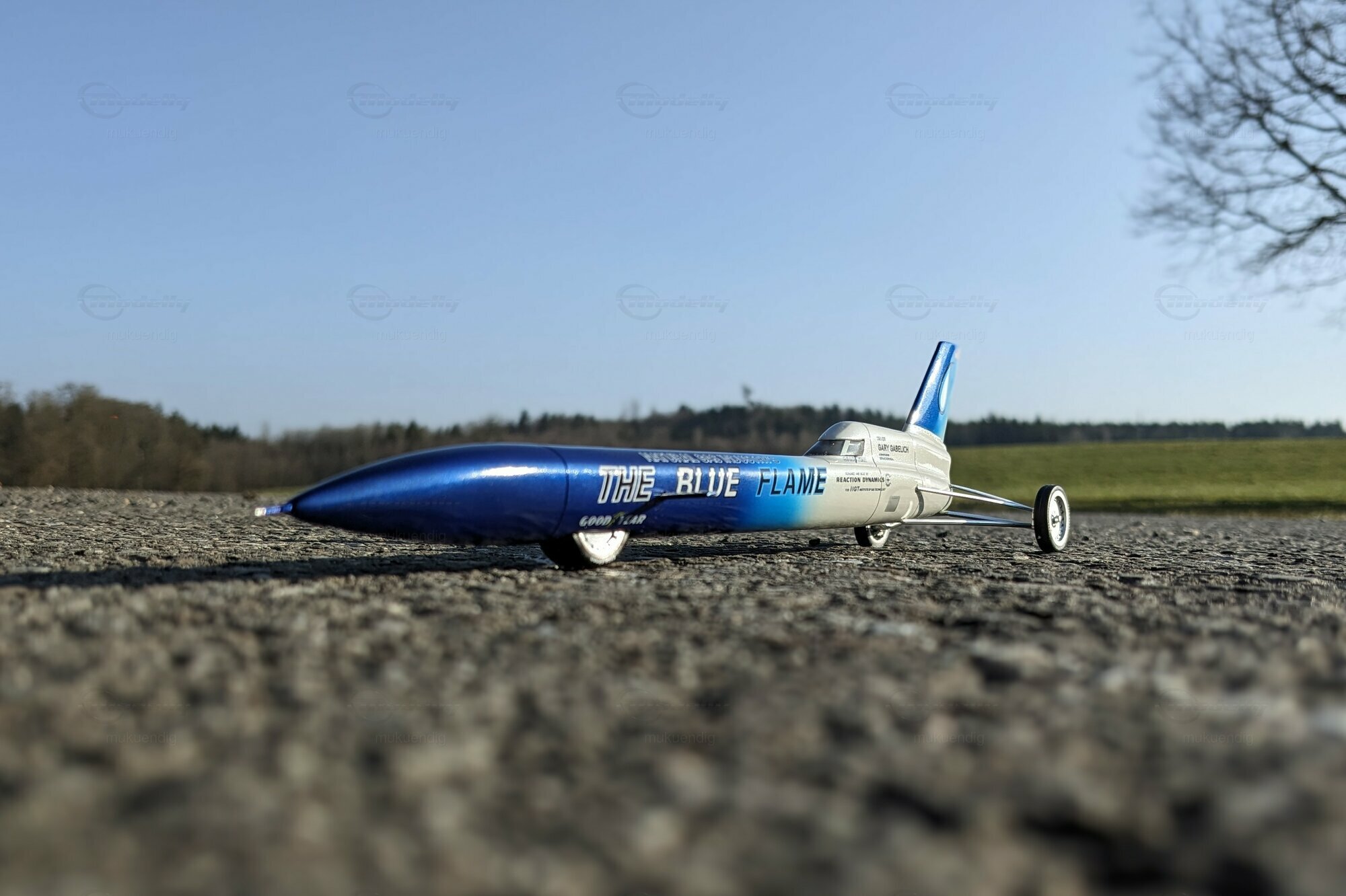
- Blue Flame Bonneville 1014km/h Oktober 1970 GARY GABELICH (from 1970)
- Bizarre
- 1:43
- Showcase model / No engine
- resin
- white
- Perfect mint condition
- Original packaging exists
- Not for sale
Land speed record 1970: context and history of the original
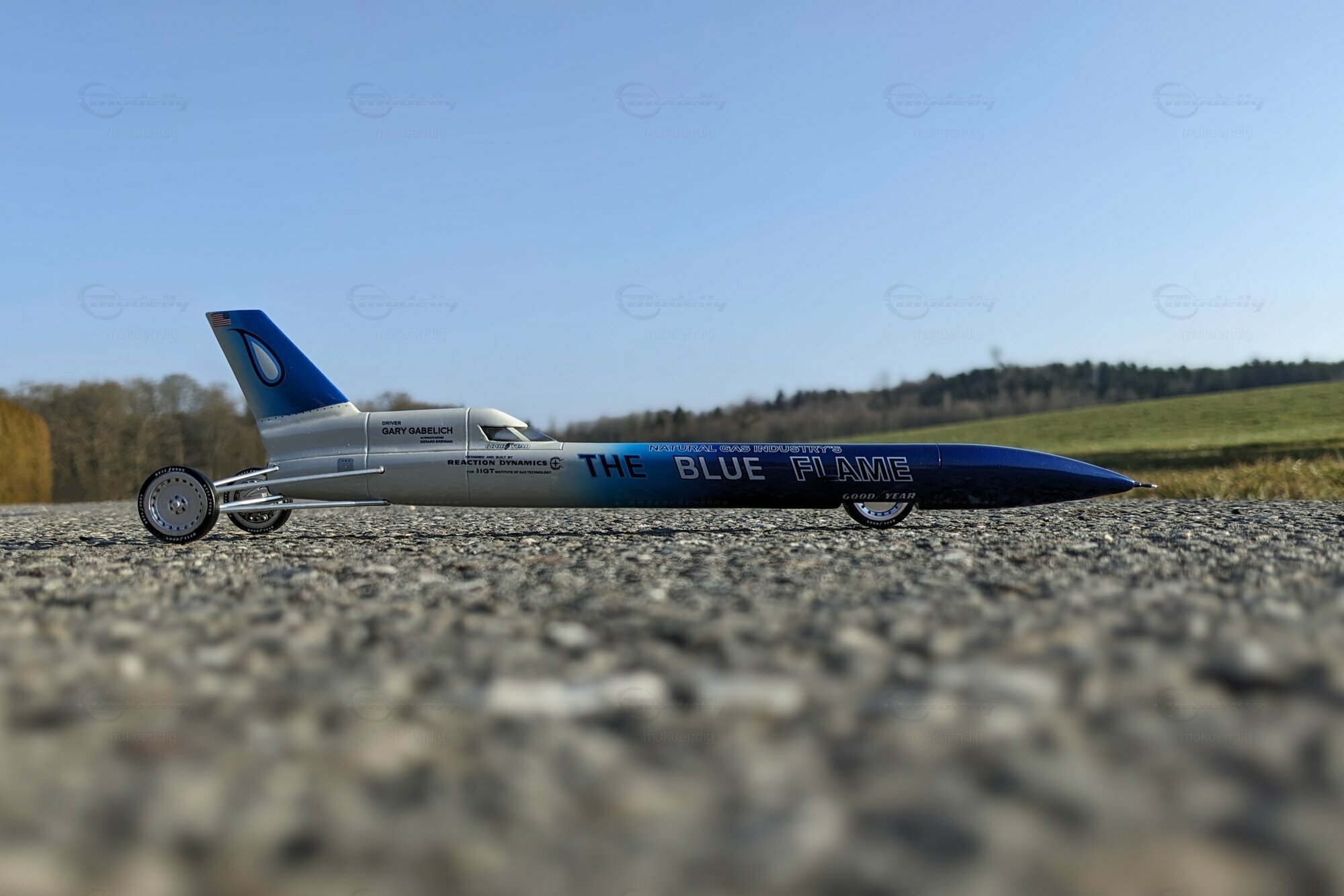
The model is based on the rocket car The Blue Flame, which set the land speed record on 23 October 1970 at the Bonneville Salt Flats in Utah. Piloted by Gary Gabelich, The Blue Flame reached an officially averaged speed of 1014.656 km/h (630.37 mph) over the mile and 1001.667 km/h (622.38 mph) over the kilometer. That pushed Craig Breedlove’s jet‑powered “Spirit of America – Sonic 1” from 1965 off the top spot. The Blue Flame was developed by Reaction Dynamics Inc. with backing from the U.S. natural gas industry, which you can clearly see on the car’s livery. This was the first and only generation of that record car; construction started around 1969 and it was finished for the record runs in 1970. Its extremely slim layout, three‑wheel setup and central tail fin mark The Blue Flame as a design aimed at minimal frontal area and very low drag for the salt flats.
Technology: rocket drive, dimensions and layout of The Blue Flame
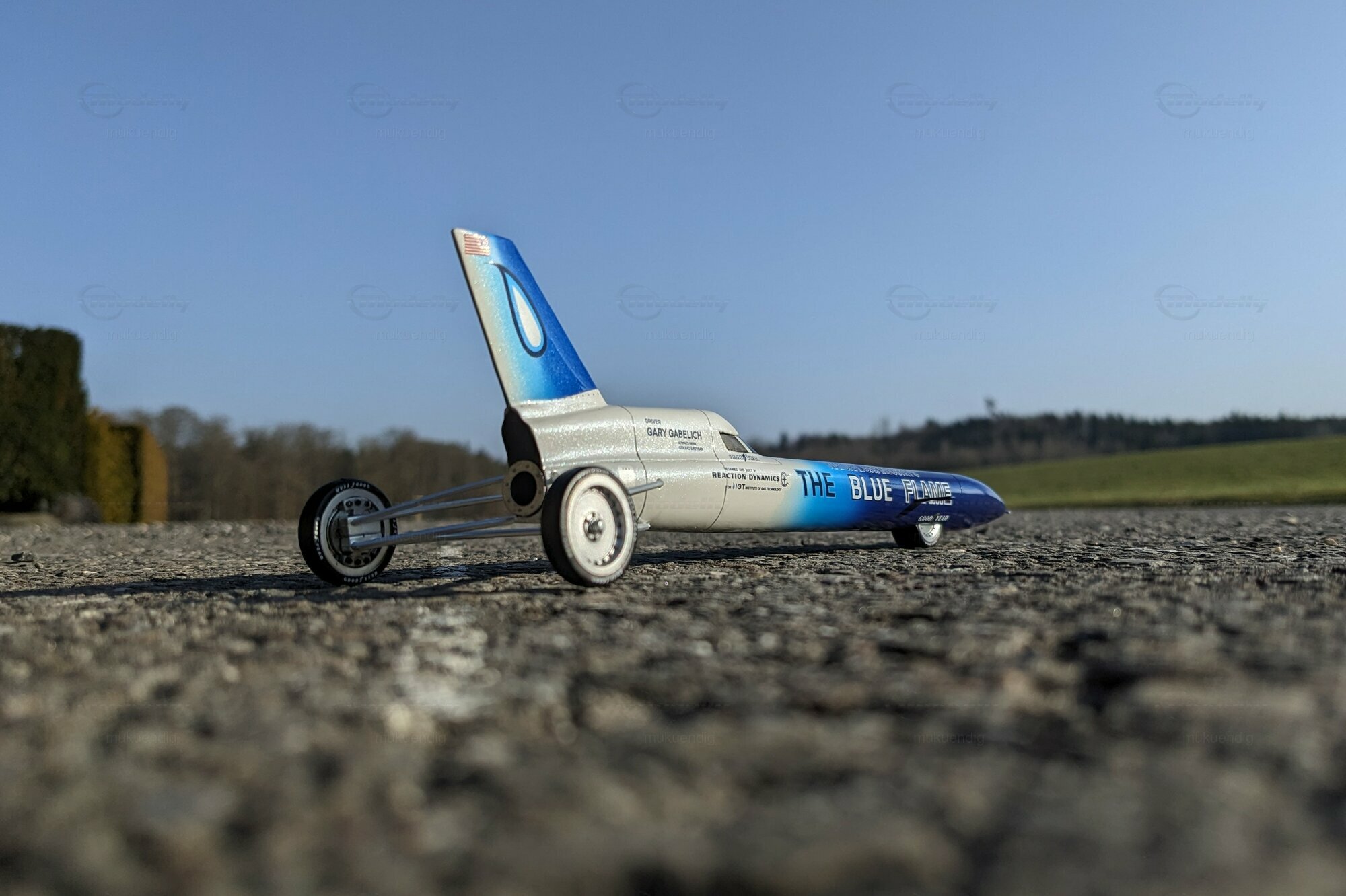
At its core, The Blue Flame used a throttleable rocket engine developed by Reaction Dynamics. The oxidizer was high‑test peroxide (about 90%), and the fuel was liquefied natural gas (mainly methane). The propellants were fed under pressure and the mixture ratio could be varied so the thrust could be tuned to track conditions. Sources cite a thrust on the order of up to roughly 98 kN (98 kN (22,030 lbf)). The body of The Blue Flame was about 11.5 meters (37.7 feet) long and extremely narrow. The chassis used a three‑wheel arrangement: two exposed rear wheels on outriggers and a small front wheel set well forward in the fuselage. A vertical tail fin stabilized The Blue Flame at high speed; the pointed nose and near‑cylindrical center section reduced boundary‑layer disturbance. It ran on special Goodyear high‑speed tyres mounted on closed rims to avoid turbulence. The driver sat under a small, streamlined canopy in the front third of the fuselage. The natural gas industry sponsorship was very visible on the car, along with Goodyear branding and other decals — a clear sign of the project’s backers.
The model in the collection: Bizarre 1/43 resin
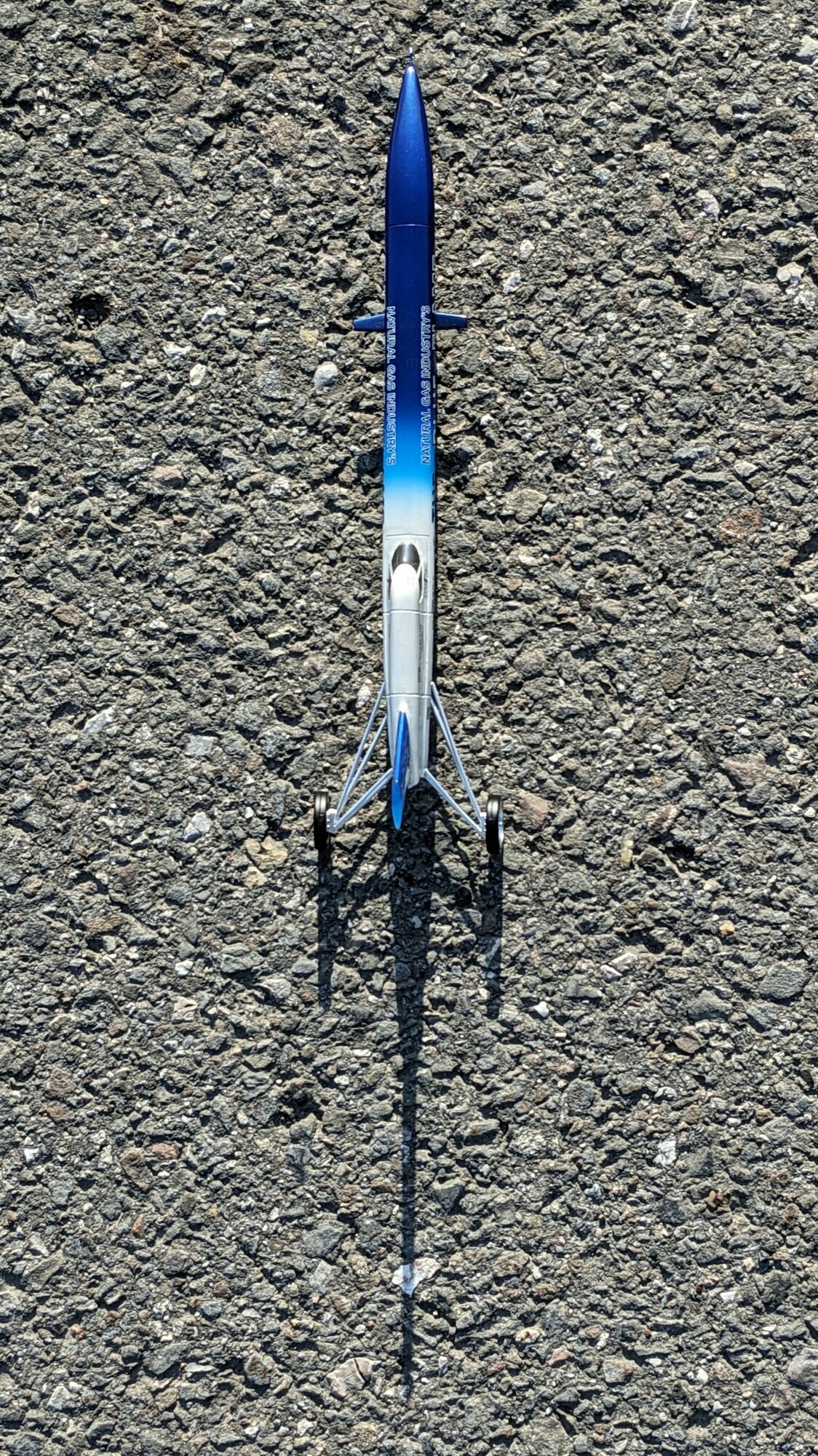
This miniature comes from Modelly member “mukuendig” and represents The Blue Flame at 1/43 scale. It’s a Bizarre model cast in resin, which helps reproduce the car’s very slim fuselage cleanly. The photos show the pointed nose, the tiny cockpit and the separately mounted rear outrigger arms clearly. The small, partly faired front wheel sits correctly far forward under the fuselage, matching the real tricycle layout. The paint is a two‑tone finish: a dark metallic blue at the front that fades into a light silver. The big side lettering “THE BLUE FLAME” is printed as on the original, along with the natural gas and Reaction Dynamics markings and the driver name “Gary Gabelich.” The fin carries a US flag and a droplet logo referencing natural gas. The rims show Goodyear lettering; the tyres are narrow and slick, appropriate for a high‑speed car. Proportions look right, panel edges are crisp, and the decals are well placed — all things resin casting can do nicely at this scale. The central tail exhaust and slim fin are well defined, so the technical feel of The Blue Flame comes across convincingly.
Details, styling and collector’s notes
For collectors, what’s interesting is how faithfully this model captures the specifics of The Blue Flame in a tiny package. The photos show the very low ground clearance, which makes the profile look flat and keeps the line from nose to nozzle unbroken. The car’s aerodynamics are echoed by the smooth body surface of the model, which has no distracting seams. The blue–silver fade is clean and matches the historic promotional graphics. The small canopy with the driver name, the vertical tail fin with flag and droplet, the exposed rear arms and the barely visible front wheel together make a recognisable image of the record car. This 1/43 Bizarre resin model is a nice fit for collections focused on land speed record cars, American rocket cars, or technical milestones in motorsport. Resin lets the maker achieve fine contours and thin walls, which suits the long, slim body. In a display case the miniature looks tidy thanks to its simple lines and restrained colour scheme; the contrasting decals are readable and give you the who/what/where at a glance. If you’re interested in the historical context, it’s worth comparing the car to Breedlove’s “Spirit of America – Sonic 1” — only by beating that design did The Blue Flame set the benchmark for later record attempts. All in all, the piece owned by “mukuendig” shows the design idea of the original in a compact, detail‑focused way without unnecessary deviations from the technical look.
Chriskitt
Auto-translated
 Great Car!
Chriskitt
Auto-translated
 Great Car!