
Ford GT40 MK II(diecast 1:18, Exoto Racing Legends)
- Ford GT40 MK II (from 1966)
- Exoto Racing Legends
- 1:18
- Showcase model / No engine
- diecast
- yellow
- 18047
- Not specified
- Not specified
- Not for sale

Ford GT40 Mk II as the inspiration: development, generation, and tech
This collectible shown here is based on the Ford GT40 Mk II, the second, more powerful evolution of the GT40. This generation belongs to the Mk II generation and was built starting in 1966. Its direct predecessor was the Ford GT40 Mk I, which used a smaller small-block V8 and laid the groundwork for the later upgrade. The GT40 was developed in the orbit of Ford Advanced Vehicles and Shelby American; among the key names linked to its development are Eric Broadley, Roy Lunn, and Carroll Shelby. The car was designed as a compact mid-engine sports prototype, with a steel monocoque, very low height, and a body shape aimed at high top speed and reduced frontal area. With the Mk II, Ford used the 7.0-liter Ford V8 from the FE family. Power, depending on setup, was well over 450 hp, sometimes even more. Other typical features included a reinforced cooling system, larger brakes, revised aerodynamic details, and a transmission adapted for the heavy loads. It was especially the mix of big-displacement V8, low silhouette, wide track, and coupe-like proportions that made the Ford GT40 Mk II one of the most technically striking endurance racers of its time.
Motorsport success of the Ford GT40 Mk II in endurance racing
In motorsport, the Ford GT40 Mk II is most famously tied to the 1966 season. Its best-known win was the overall victory at the 1966 24 Hours of Le Mans, where Ford finished first, second, and third. The winning car, driven by Bruce McLaren and Chris Amon, was a Mk II, as were the much-discussed team cars of Ken Miles and Denny Hulme, and Ronnie Bucknum and Dick Hutcherson. That effort marked Ford’s breakthrough in direct competition with Ferrari on the endurance stage. The Mk II also played an important role at Daytona and Sebring in 1966. The car was specifically built to keep running at high speed over long distances without losing reliability.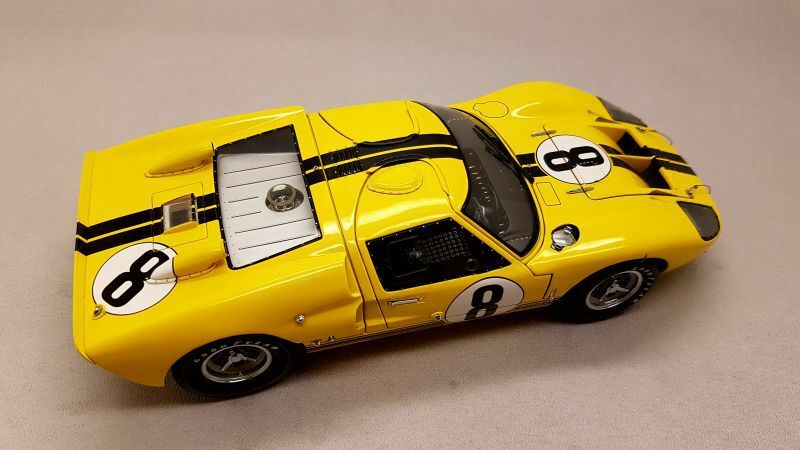
Drivers, teams, and racing history: Alan Mann Racing and start number 8
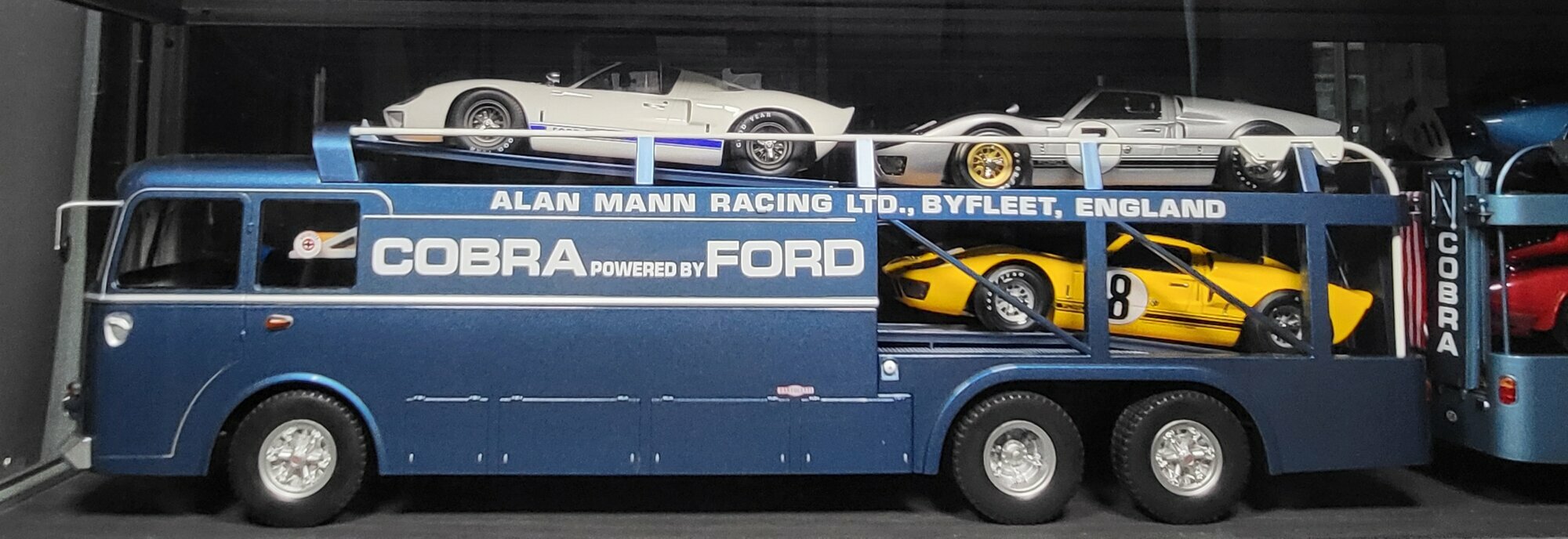
Alongside Shelby American, Alan Mann Racing also ran GT40 cars within Ford’s factory structure. The model shown in the photos clearly points, through the transporter lettering and color scheme, to Alan Mann Racing from Byfleet, England. The yellow paint with the black start number 8 recalls cars from Ford’s endurance and testing efforts in the 1960s. Depending on the event and chassis, the exact number and driver pairings can vary, so it’s best to be careful when identifying a model this way. What is known, though, is that a lot of well-known drivers raced different GT40 versions, including Dan Gurney, Jerry Grant, Jo Schlesser, Graham Hill, and later Jacky Ickx in GT40 variants. For collectors, the big thing here is that the model shows a very specific racing livery with a team connection, which gives it a clear place in Ford GT40 history.Exoto Racing Legends 1/18 model car: details, diecast build, and visible features
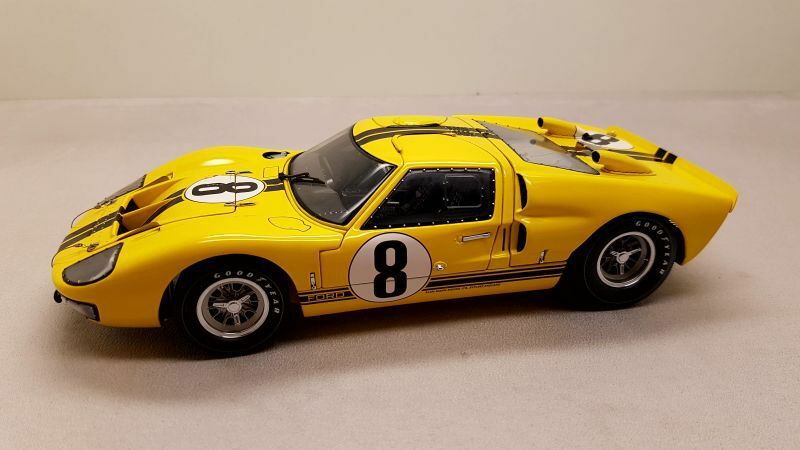
The piece shown here from Modelly member Phat-T’s collection is a model car in 1/18 scale, made by Exoto Racing Legends. It is built as a diecast model car, meaning it’s made from metal casting. The model car in 1/18 scale, made by Exoto Racing Legends, shows a closed GT40 with the low proportions typical of the Mk II, the long nose, the compact cabin, and the sharply sloping rear. You can see the round number panels with the black 8 on a white background on the doors, front, and rear area. The paint is yellow, with two black longitudinal stripes running over the front, roof, and tail. There are also fine lower-body stripes with Ford lettering. The tires are marked Goodyear, which is an important visible sponsor or supplier detail. You can also make out silver wheels, side air intakes, roof details, hood pins, and the classic GT40 window shape. The model sits on the Alan Mann transporter shown alongside it, which makes the team connection really easy to understand in a display.Paint scheme, shape, and the look of the 1/18 GT40 model for collectors
From a collector’s point of view, the model stands out mainly because of its clean racing look. The yellow base color is broken up by the black twin stripes, which emphasize the car’s lengthwise shape. The white round number panels with the 8 create a strong contrast and follow the classic layout of vintage racing markings. There are also fine body lines around the fenders, doors, and air outlets, which really come through nicely in 1/18 scale. In the photos, you can also spot the flush-fitting windows, the attached side mirrors, the suggested fuel and service caps, and the accurately represented light units. Together with the blue Cobra transporter, it creates a coherent picture of a team vehicle and race car like you’d expect from Ford’s 1960s racing world. The model’s matter-of-fact appeal comes from its low, wide stance, the clean separation of the color areas, and the obvious motorsport markings. For international model car and miniature collectors, this mix of historic racing inspiration, team context, and visible detail work is exactly what makes this Exoto piece interesting.- Write a first comment about this model now!Any comment can be discussed by all members. It's like a chat.Mention other Modelly members by using @ in your message. They will then be informed automatically.
- Write a first comment about this model now!Any comment can be discussed by all members. It's like a chat.Mention other Modelly members by using @ in your message. They will then be informed automatically.