
Ford GT40 MK II(diecast 1:18, Exoto Racing Legends)
- Ford GT40 MK II (from 1966)
- Exoto Racing Legends
- 1:18
- Showcase model / No engine
- diecast
- red
- 18044
- Not specified
- Not specified
- Not for sale
Le Mans icon and its precise replica
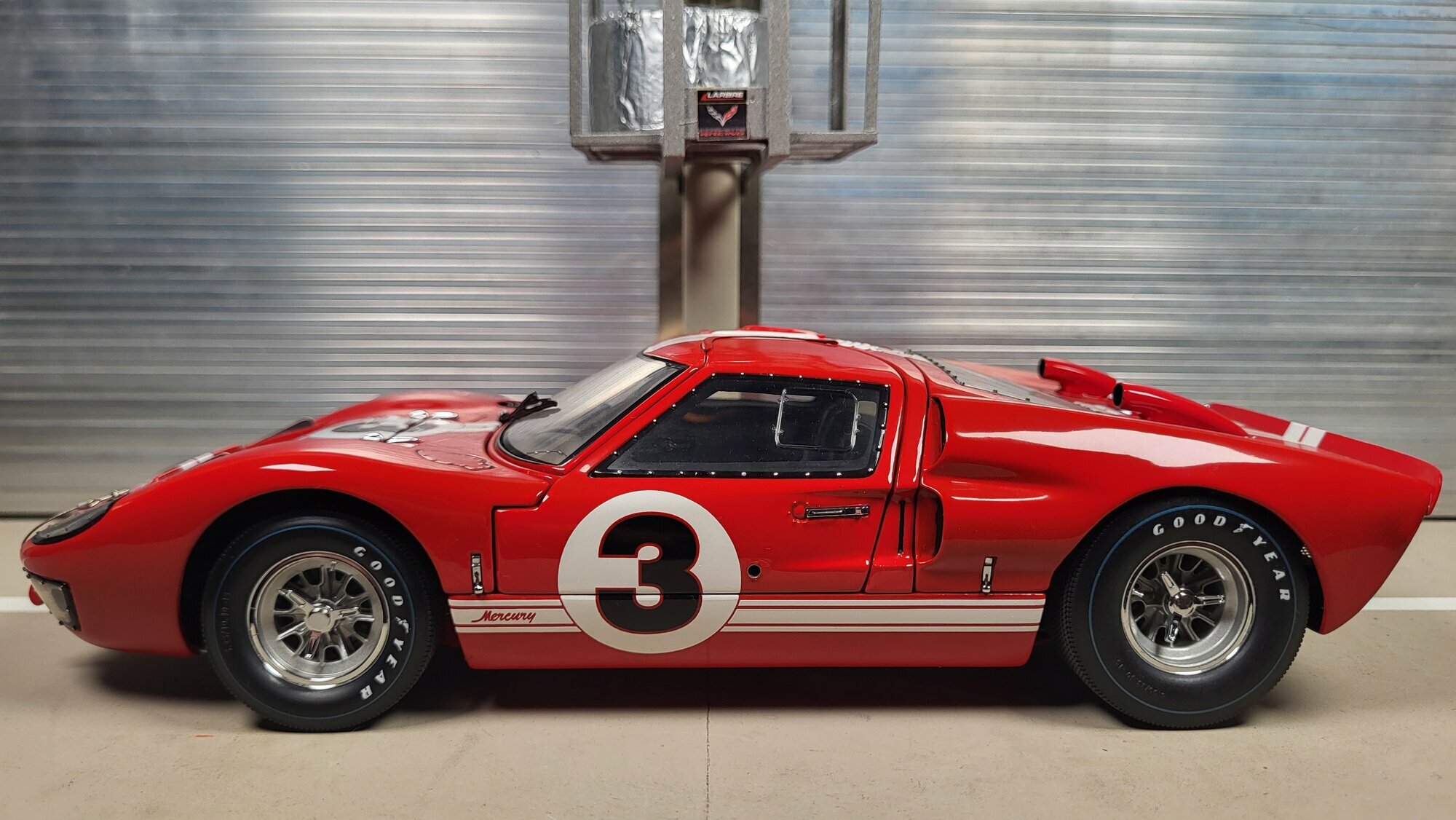
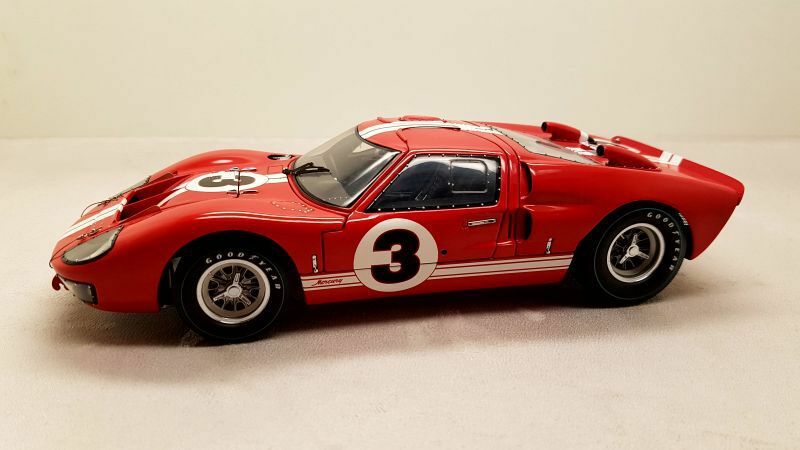
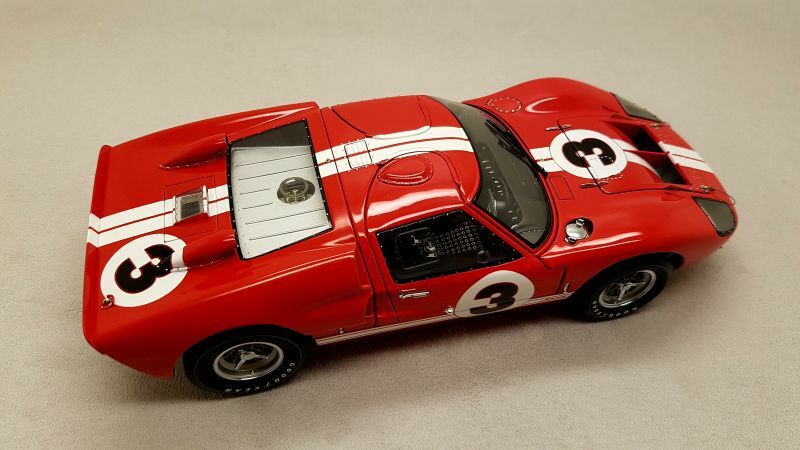
This model shown here belongs to Modelly member “Phat‑T” and is based on the Ford GT40 Mk II. The pictures show a car with a red base coat, white double stripes and big circular race numbers with a “3”. The Ford GT40 Mk II marks the MK II generation of the GT40 program, built in the years 1966–1967. The original was developed to dominate endurance racing — especially the 24‑hour race at Le Mans. This diecast model is made in 1/18 scale by Exoto Racing Legends and captures lots of details from the racing version, including the distinctive front air openings, the low‑set cockpit and the characteristic Halibrand wheels with tire lettering. The miniature is made from diecast metal, so it feels properly solid and has tight panel gaps. Even in the photos you can see rows of rivets, hood fasteners and clear headlight covers nicely worked out. This replica is aimed at collectors who want a serious, accurate copy of one of the most famous American–British racing projects.
Development, engineering and context of the original
The Ford GT40 Mk II grew out of Ford Advanced Vehicles’ GT40 program. Earlier experience with the Mk I — the predecessor with a 4.7‑liter V8 (≈1.24 US gallons) — showed potential but also weaknesses in durability and driveline. For the Mk II, people like Roy Lunn, John Wyer, Carroll Shelby and Eric Broadley got involved. The chassis stayed a lightweight steel‑sheet monocoque but got an overhauled cooling system, stronger hubs and reinforced control arms. The heart was the 7.0‑liter Ford‑FE V8 “427” (≈1.85 US gallons). Power figures varied by tune; around 360–380 kW (about 480–510 hp) is a common estimate, combined with a dry sump, large fans and big Weber carburetors. Other features included ventilated disc brakes with quick‑change hubs, dry‑sump lubrication, large fuel tanks and aerodynamic cooling ducts. All that gave the Ford GT40 Mk II a top speed beyond 320 km/h (199 mph) — a crucial advantage for the long straights at Le Mans. The MK II generation replaced the Mk I as the competition car and was built in small numbers in 1966–1967, by outfits like Shelby American and Holman‑Moody.
Racing history: Daytona and Sebring as proving grounds
Its first full season was 1966. At the 24‑hour race at Daytona the Mk II scored a 1‑2‑3 win. Cars run by Shelby American won with driver pairings like Ken Miles/Lloyd Ruby and Dan Gurney/Jerry Grant. The 7.0‑liter engine’s power and the robust brakes helped deliver consistent stints. At Sebring 1966 the story repeated with another 1‑2‑3 result; crews including Ken Miles/Lloyd Ruby and Jerry Grant/Dan Gurney were at the front. Technical measures like the tough T‑44 gearbox, oversized radiators and fast‑change brake components paid off in both reliability and pit turnaround times. The Ford GT40 Mk II proved itself in North America as a reference car for endurance racing and set the stage for the main goal: Le Mans.
Le Mans 1966 and international reaction
Internationally the Ford GT40 Mk II is best known for the 1‑2‑3 at the 24 Hours of Le Mans in 1966. Shelby American and Holman‑Moody cars beat Ferrari. The win went to Bruce McLaren and Chris Amon, ahead of Ken Miles/Denny Hulme. Third was Ronnie Bucknum/Dick Hutcherson. The cars covered a then‑impressive distance of over 4,800 kilometers (about 2,983 miles). The team strategy — controlled engine revs, careful tire management and coordinated pit work — made that result possible. In 1967 Ford continued the program with the later Mk IV; Mk II cars still raced on, especially in North American endurance events. Drivers like A. J. Foyt, Mario Andretti and Jo Schlesser piloted GT40 variants over time, which cemented the Ford GT40 Mk II as a key reference in sports‑car world championship history. It’s clearly the link between the smaller Mk I and the later prototype developments.
Phat‑T’s miniature: livery, sponsors and scale details
The Exoto pieces in the photos show the red paint with white twin stripes and the number “3” circle, a look you saw on several Holman‑Moody/Shelby cars. On the rocker panels you can spot the Mercury badge, a nod to Ford’s sibling brand. The tires have readable Goodyear markings. The front has inset headlight covers, hood pins and little screw heads along the window frames. Behind the cockpit you can see the intake snorkels and the engine cover with the fuel filler replicas. This model is a 1/18 scale Exoto Racing Legends diecast — metal body with fine plastic and photo‑etched parts — which gives a realistic look. In Phat‑T’s collection the miniature reads true thanks to correct proportions, clean number printing and faithfully rendered Halibrand wheels. Doors and hood seams are even, the interior shows a suggested dash, belts and the low driving seat. If you look closely at the photos you’ll spot the sliding side window, the typical NACA ducts on the nose and the single central wiper — little details that read exactly like the Ford GT40 Mk II and that show the quality of Exoto Racing Legends in the 1/18 segment.
- Write a first comment about this model now!Any comment can be discussed by all members. It's like a chat.Mention other Modelly members by using @ in your message. They will then be informed automatically.
- Write a first comment about this model now!Any comment can be discussed by all members. It's like a chat.Mention other Modelly members by using @ in your message. They will then be informed automatically.