
Dodge Charger(1:32, Scalextric)

- Dodge Charger (from 1970)
- Scalextric
- 1:32
- Slotcar
- plastic
- black
- online dealer (Amazon)
- 57,50 EUR
- Perfect mint condition
- Original packaging exists
- Not for sale

Icon of the muscle‑car era and its miniature at Modelly
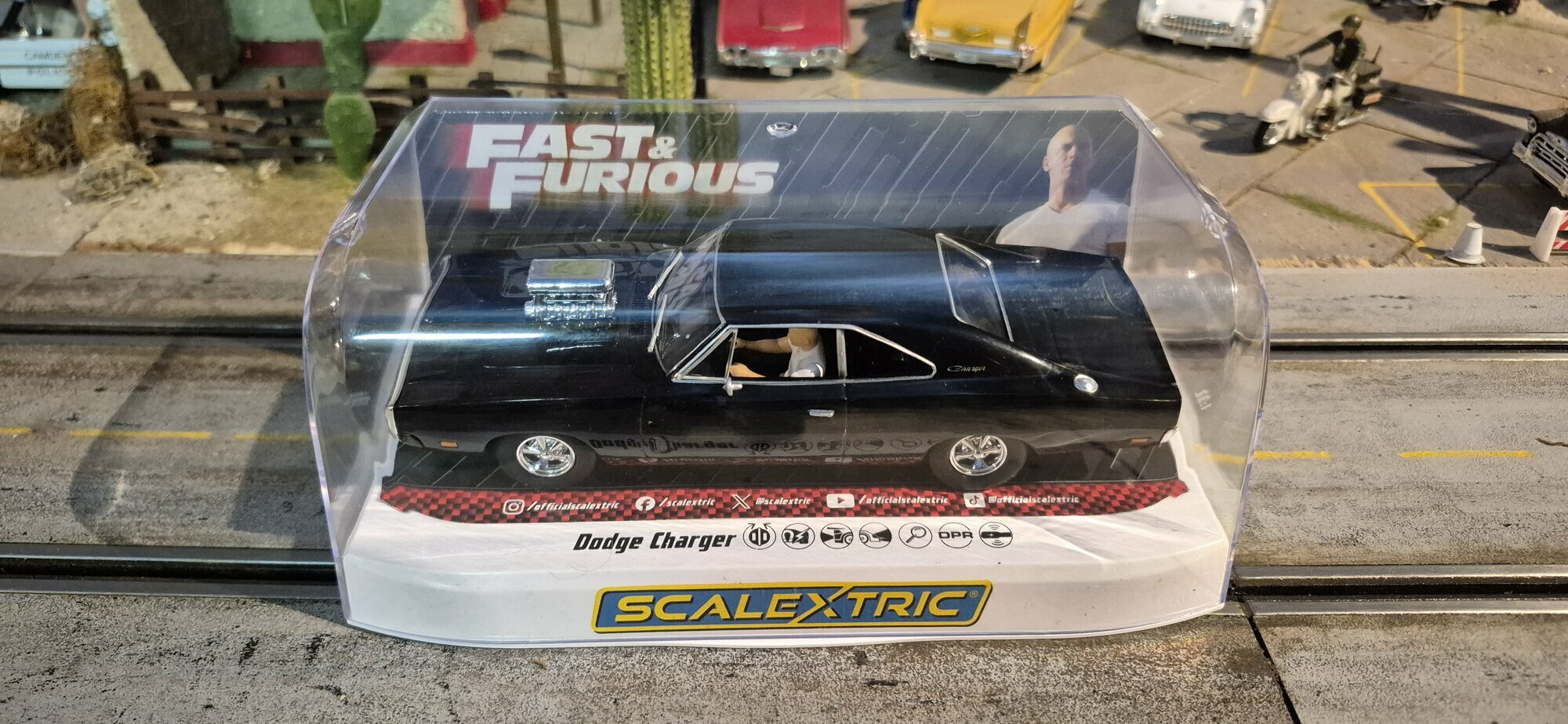
In the collection of the Modelly member “sparksfly” there’s a detailed slot car that’s clearly inspired by the Dodge Charger. The photos show the familiar silhouette with the long hood, fastback rear and the distinctive hood scoop. The packaging with the big “Fast & Furious” logo points to the film reference. Important for collectors: this is a model car in 1/32 scale from Scalextric. The vehicle is made of plastic, so it’s a plastic model, and it’s a slot car that’s electrically driven via the two power rails of the track. You can see the typical guide blade, pickup shoe and the lit taillights. The miniature brings the look of the original to the track and adds an internationally famous US muscle car to “sparksfly”’s display.
Historical background: Second generation Dodge Charger
The real car this miniature is based on is the second generation Dodge Charger, built from 1968–1970. Its direct predecessor was the first Dodge Charger (1966–1967) on the same B‑Body platform. The design introduced in 1968 is mostly credited to Chrysler stylist Richard Sias; notable features are the “Coke‑bottle” side profile and the so‑called “flying buttresses” at the rear. Technically, the Dodge Charger used a unibody construction, torsion bars at the front and leaf springs at the rear. On the power side the lineup ranged from smaller V8s up to big performance engines. Especially famous are the 7.2‑liter (440 cu in) “440 Magnum” and the 7.0‑liter (426 cu in) “426 Hemi”, whose development at Chrysler was significantly shaped by Tom Hoover. Factory figures for the 426 Hemi were ≈ 317 kW (425 hp) in SAE gross terms. Mated to that were either the 3‑speed automatic “TorqueFlite” or a 4‑speed manual gearbox, sending power to the rear wheels. With the Hemi, the Charger could run quarter‑mile times around 13.5 seconds, which made it a drag‑racing performer and helps explain its later movie fame. In 1968 — the year this generation was introduced — things like the founding of Intel, the release of the Beatles’ “Hey Jude,” and the Apollo 8 lunar orbit happened; those sorts of examples help place the car in historical context.
Film connection: the Fast & Furious interpretation
The shown miniature obviously references the black Charger from the Fast & Furious film series. In the first movie from 2001 the car appears in several key scenes, especially in a street race where it ultimately faces a Toyota Supra. The film car is driven by Dominic Toretto, played by Vin Diesel, and his rival/friend Brian O’Conner, played by Paul Walker, is in the Supra. The Charger launches off the line with the front end lifting, puts down brutal acceleration and later gets involved in a train‑crossing crash — images that made the car world‑famous. For the film look a huge blower sticking out of the hood was used, paired with plain, low five‑spoke wheels and a flat black paint job. Those exact traits are visible on the model: glossy black paint, chrome bumpers and trim, and the “Charger” badges on the rear C‑pillars. The taillight arrangement and the sloping roofline capture the shape of the real Dodge Charger well, so the movie association is easy to see for collectors.
The slot car in detail: tech, finish and presence
As a slot car this model is a working, electrically driven miniature that picks up current via a pickup shoe and drives the motor through a pinion and crown gear. In “sparksfly”’s photos the glowing rear lights are visible; the front is lit too, which makes it easy to see on the track. The body is neatly molded plastic, the windows are clear inserts, the interior has a driver figure and the wheels are chromed. The proportions of the body translate the Charger’s lines into the scale, and panel lines on doors, hood and bumpers are clean. The model shows a deep black, smooth finish without extra stripes or contrasts; only the chrome bits — grille, window trim, exhaust tips — add highlights. The small “Charger” badge is correctly placed on the side. It’s also “DPR”‑ready (Digital Plug Ready), so you can convert it to a digital slot system easily. These features are typical for Scalextric products and make for reliable track performance. One more clear note for collectors: it’s a 1/32 scale model from Scalextric. The combo of black paint, subtle chrome and the oversized blower gives the miniature a solid presence without being over the top. If you want a historical anchor: the real second‑generation car was built from 1968–1970, a period of intense technical development in US carmaking. With these facts and the faithful execution, the slot car is a nice addition to collections focused on the Dodge Charger and the film series.
Dom's Charger Fast Furious 1
Chriskitt
Auto-translated
 Hot Karren! 👍 👍 👍
Chriskitt
Auto-translated
 Hot Karren! 👍 👍 👍