
Mazda RX-7 FD-3S(1:18, Ignition Models)
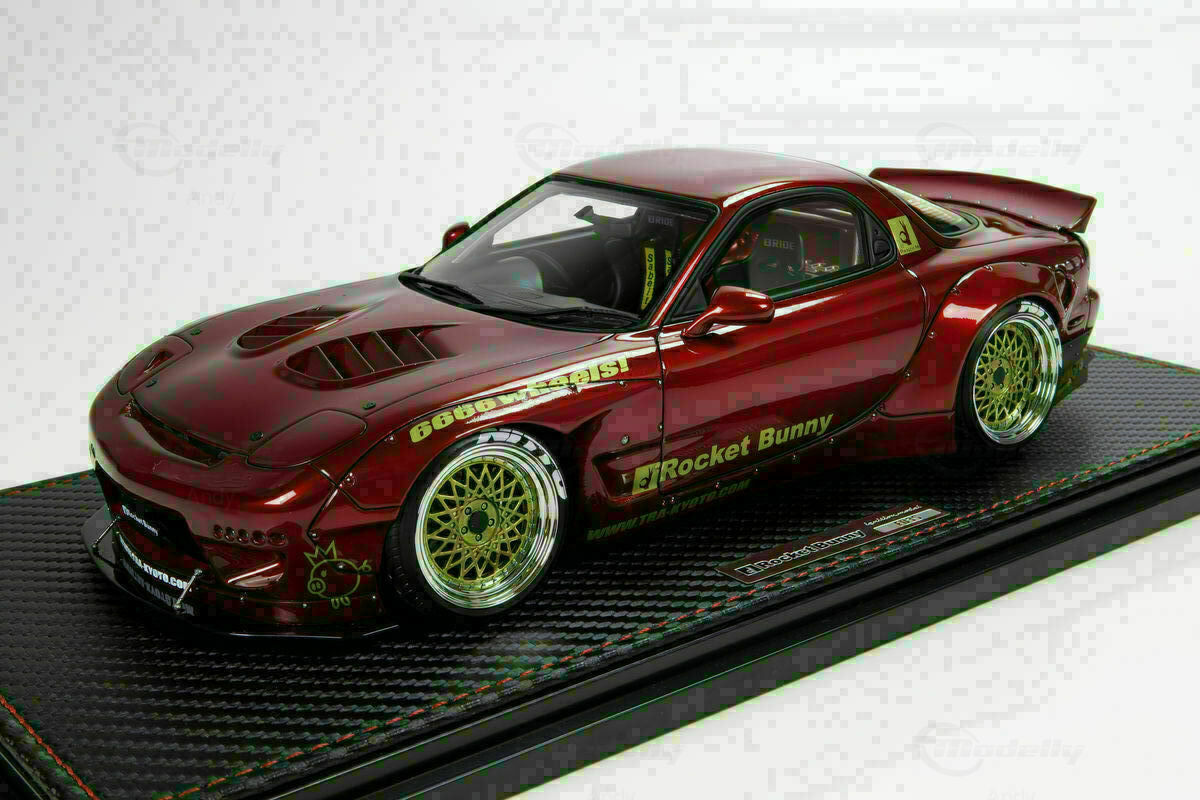
- Mazda RX-7 FD-3S (from 1991)
- Ignition Models
- 1:18
- Showcase model / No engine
- resin
- red
- In near mint condition
- Original packaging exists
- Not for sale
Mazda RX-7 FD3S as the base of the 1/18 model
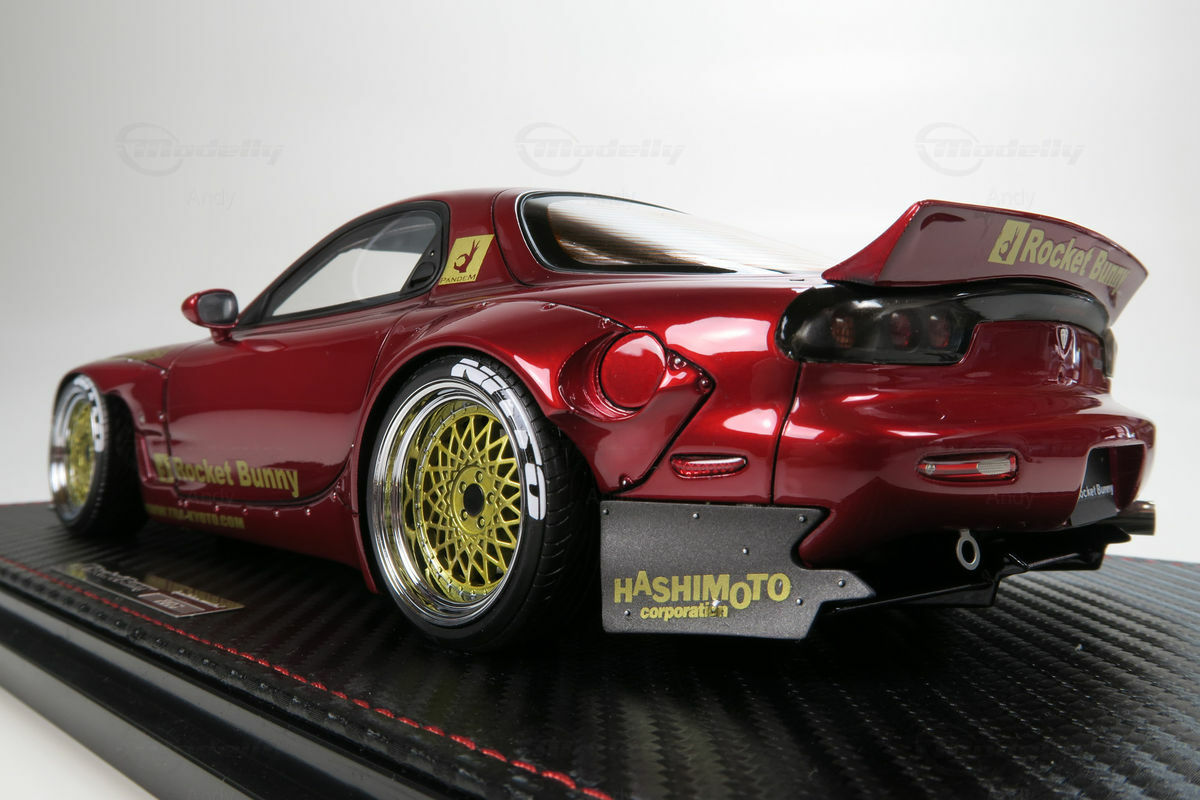
The miniature from Modelly member “Andy” is based on the Mazda RX-7 FD3S, the third generation of the RX-7 line. This generation was built from 1992 to 2002 and followed the more angular FC3S, which was produced from 1985 to 1992. The Mazda RX-7 FD3S was designed as a two-seat sports coupe with a front-mid-engine layout: the compact rotary engine sits behind the front axle, which helps create a balanced weight distribution. The car’s design is credited to Yoichi Sato, while the technical development of the RX-7 family and especially the evolution of the rotary engine concept are closely associated with Mazda engineer Kenichi Yamamoto. The FD3S has the low front end, flowing roofline, and rear lights hidden under a dark cover, all of which you can also make out on this model in scale. The production start in 1992 also helps place it in time: that was the year the Maastricht Treaty was signed, the Summer Olympics took place in Barcelona, and Dr. Dre released “The Chronic.” These events are just a nice way to help frame the car’s age and historical context.
Wankel engine and technology of the Mazda RX-7 FD3S
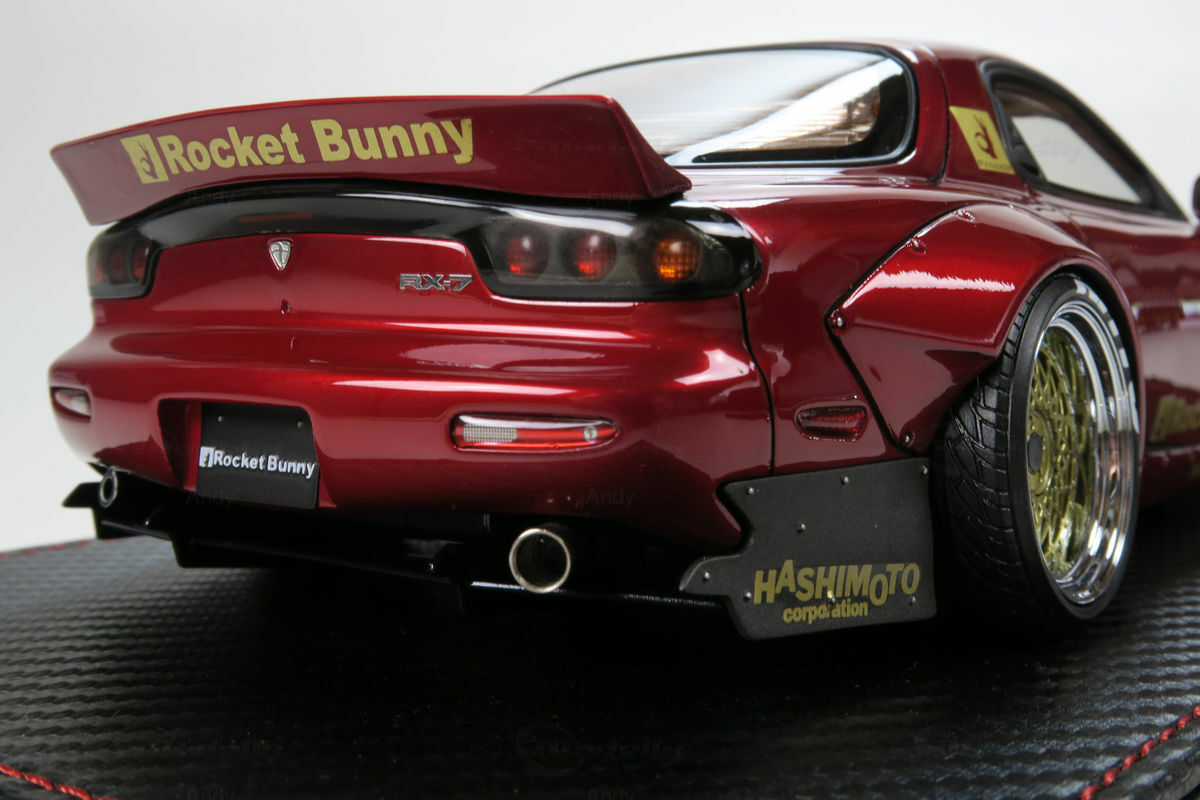
The Mazda RX-7 FD3S uses the 13B-REW, a water-cooled twin-rotor Wankel engine with 1,308 cubic centimeters (79.8 cubic inches) of chamber displacement. Mazda paired it with a sequential twin-turbo setup: at low engine speeds, one turbocharger helps first, and the second one kicks in as revs rise. Depending on year and market, power output was roughly between 255 and 280 hp; in Japan, the long-standing 280 hp limit also matched a voluntary agreement among domestic manufacturers. The engine sends its power to the rear wheels through a five-speed manual transmission or, on certain versions, through a four-speed automatic. Double wishbones at the front and rear, four wheel disc brakes, and the compact engine layout were part of the car’s technical highlights. The Mazda RX-7 FD3S was much narrower and more restrained in stock form than the version shown here. So this model is not a standard coupe, but a build with a widened body kit, a lower ride height, a big rear wing, and much larger wheels and tires.
Rocket Bunny conversion, paint, and visible details
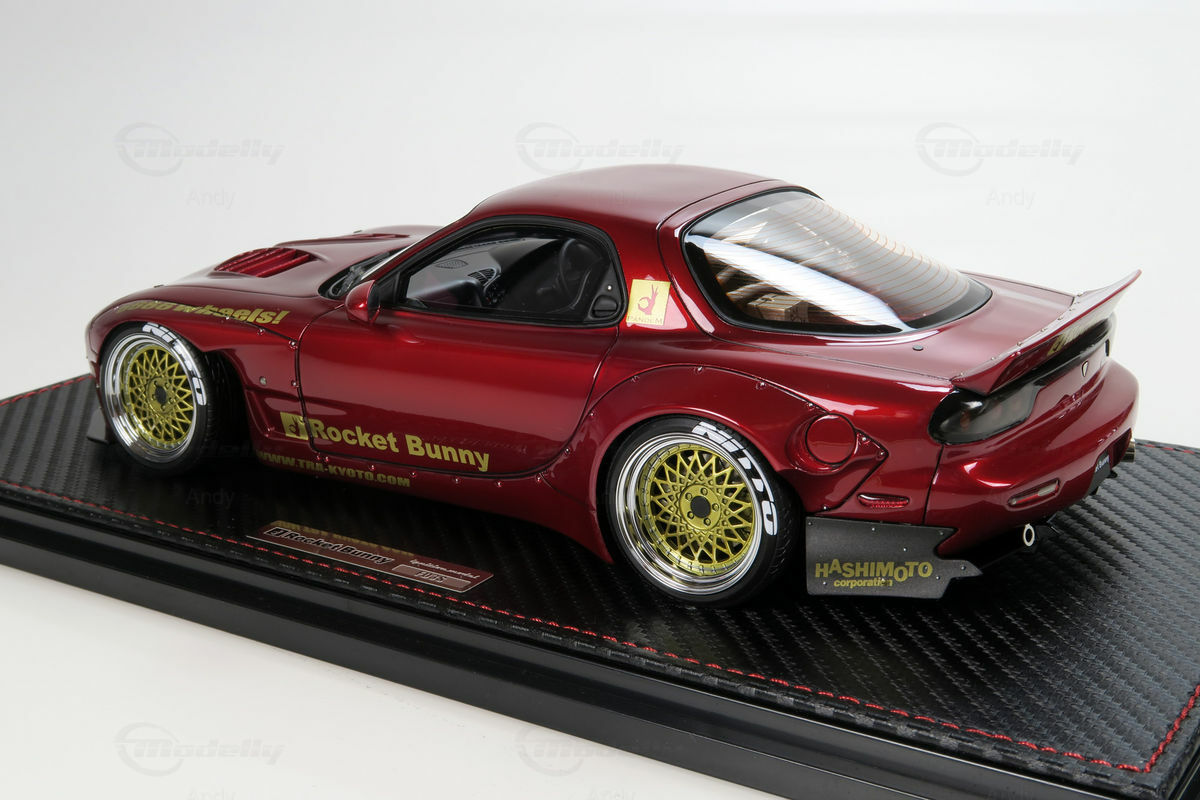
The car shown here is styled with a clearly recognizable Rocket Bunny widebody kit. Rocket Bunny is a brand developed by Kei Miura for the Japanese company TRA Kyoto, which was founded in Kyoto in 1996. Outside Japan, the program is often also marketed under the name Pandem; the yellow Pandem badge is visible on the C-pillar. Typical features of the conversion include the separately attached, bolt-on-style fender flares, the wide side skirts, the front splitter, the hood vents, and the large rear wing. At the rear, you also get a black diffuser area, side end plates with HASHIMOTO corporation lettering, and a visibly modeled exhaust system. The wheels use a gold multi-spoke mesh design with polished deep lips and very wide-looking tires; based on the photos, it is not possible to reliably identify a specific wheel brand or exact wheel model.
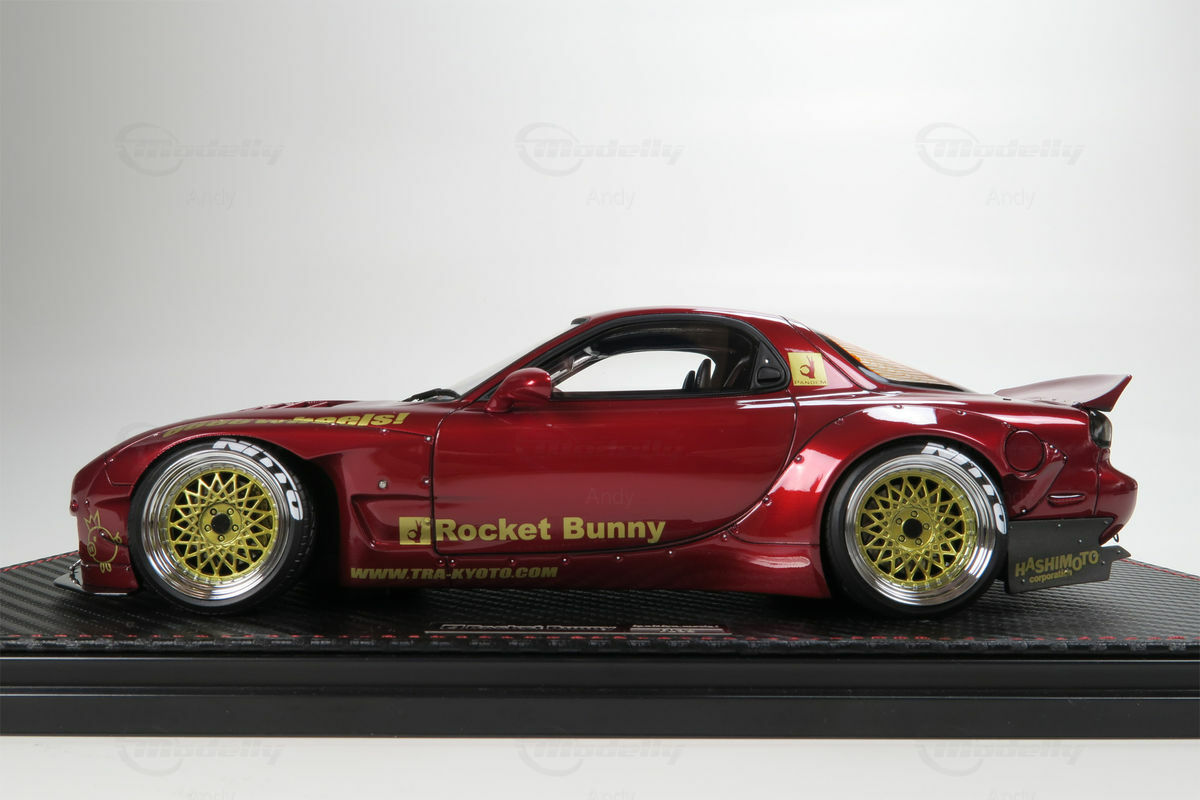
Ignition Models 1/18 resin model in Andy’s collection
This collector’s piece is a model car in 1/18 scale, made by Ignition Models. It is a limited edition miniature made from resin. Resin models usually have a sealed body structure, so the photos mostly focus on the surfaces, attached parts, and the fixed stance of the car. This model car in 1/18 scale, made by Ignition Models, comes in a dark red metallic paint that shows clear reflections on the hood, roof, fenders, and rear. The color is combined with gold lettering: the side shows Rocket Bunny and some smaller decals, and Rocket Bunny also appears on the rear wing. There are also yellow stickers on the rear side windows, a stylized bunny graphic at the front, and the number-style marking “6666” on the front fender. Black contrast pieces on the front lip, diffuser, light bar, and wheel arches break up the red body nicely. What really makes the model stand out in the photos is the mix of the low FD3S shape, the wide overfenders, the gold wheels, and the dark display base with red stitching. You can also spot interior details like sports seats with BRIDE branding, seat-belt decals, and a steering wheel on the right-hand side, which fits the Japanese setup of the displayed Mazda RX-7 FD3S.
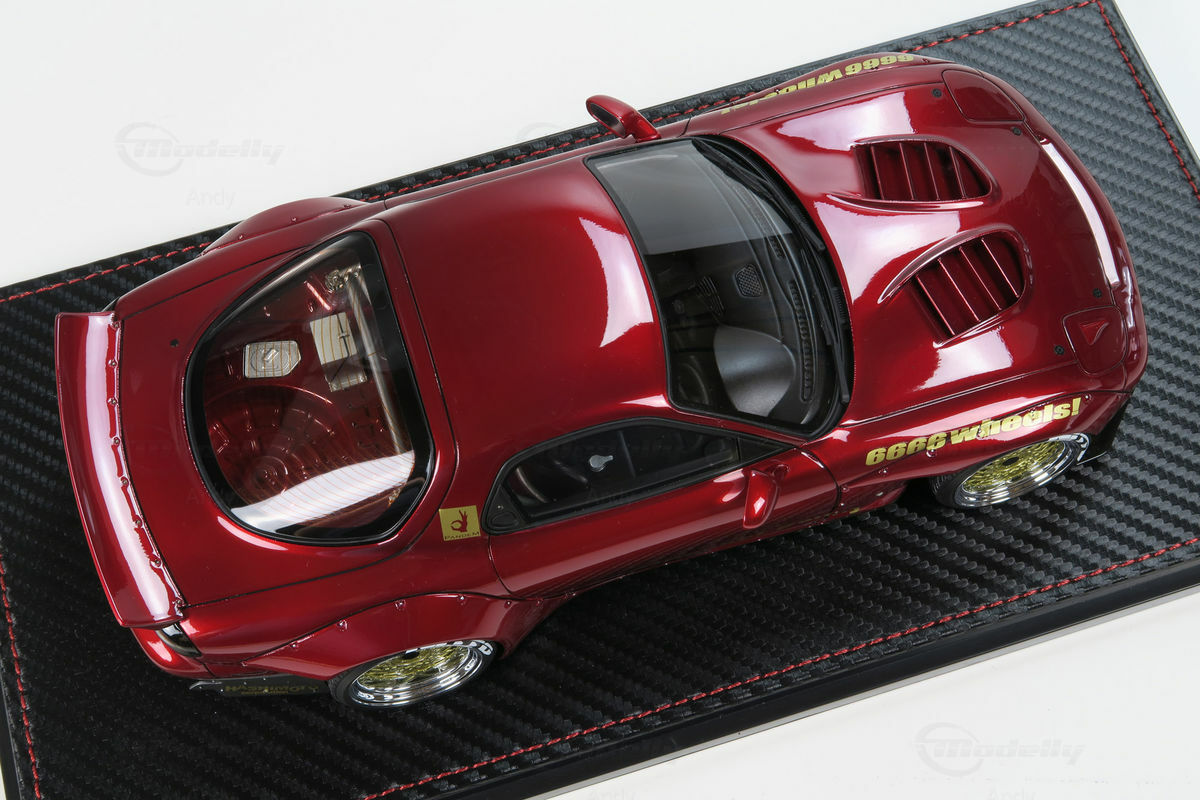
Mazda RX-7 FD3S: third generation with rotary engine
The base car for this collectible model is the Mazda RX-7 (FD3S), the third generation (FD3S) of the RX-7 lineup. It was built from 1992 to 2002 and replaced the second-generation RX-7 FC. The car’s design is credited to Mazda designer Yoichi Sato; when it comes to developing Mazda’s rotary engines, engineer Kenichi Yamamoto is especially important, since he shaped the company’s Wankel engine technology over many years. The Mazda RX-7 (FD3S) uses a 13B-REW engine mounted up front, behind the front axle, with two rotor chambers and 1.3 liters (79.3 cubic inches) of chamber volume. Its sequential twin-turbo setup uses one turbo at low revs and brings in the second one as engine speed rises. Depending on the market and model year, output was around 255 to 280 hp; later Japanese versions reached 206 kW (280 hp). A five-speed manual gearbox, rear-wheel drive, a low seating position, and a lightweight design are part of its technical identity. The 1992 model year also helps place it in time: that was the year the Maastricht Treaty was signed, the Summer Olympics were held in Barcelona, and Bill Clinton won the U.S. presidential election. These examples are just there to help give a better sense of the car’s age and historical context.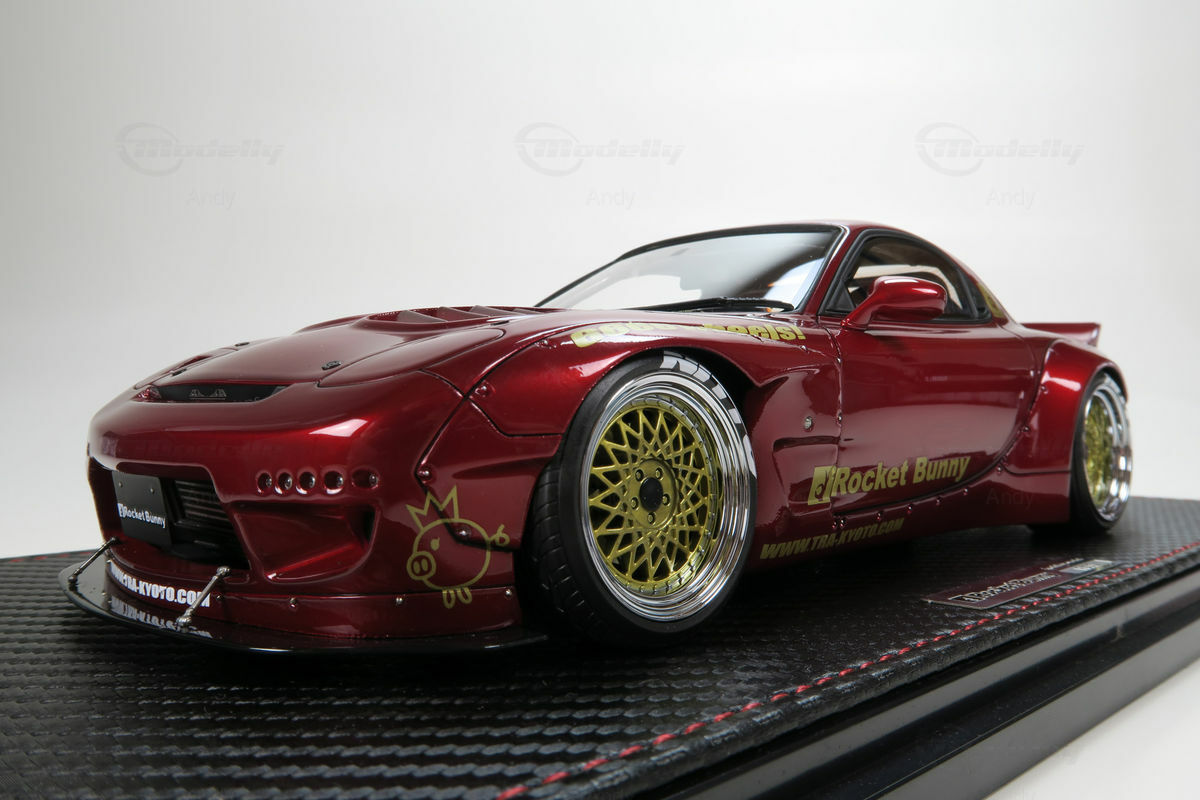
Rocket Bunny conversion as the basis for the Ignition Models model
The vehicle shown by Modelly member “Andy” is not a stock Mazda RX-7 (FD3S), but a widebody interpretation with parts from Rocket Bunny and Pandem. Both brands belong to TRA Kyoto, a Japanese tuning company from Kyoto founded by designer Kei Miura. TRA Kyoto has been around since 1996; Rocket Bunny and Pandem are known for body kits with visible bolts, widened fenders, and motorsport-style add-on parts. On the scale model, you can see a wide front splitter, bolt-on fender flares, side side skirts, a large rear wing, and a black rear diffuser. The body sits much lower than the stock car, and the wheels sit far out into the widened arches. The gold-colored, multi-piece mesh wheels have polished outer lips and visible bolt details. A specific wheel maker and exact wheel model can’t be identified clearly from the photos, so no attribution is being made here. The conversion shown here can’t be clearly tied to a specific movie or TV car either, so there’s no solid basis for claiming a direct production connection.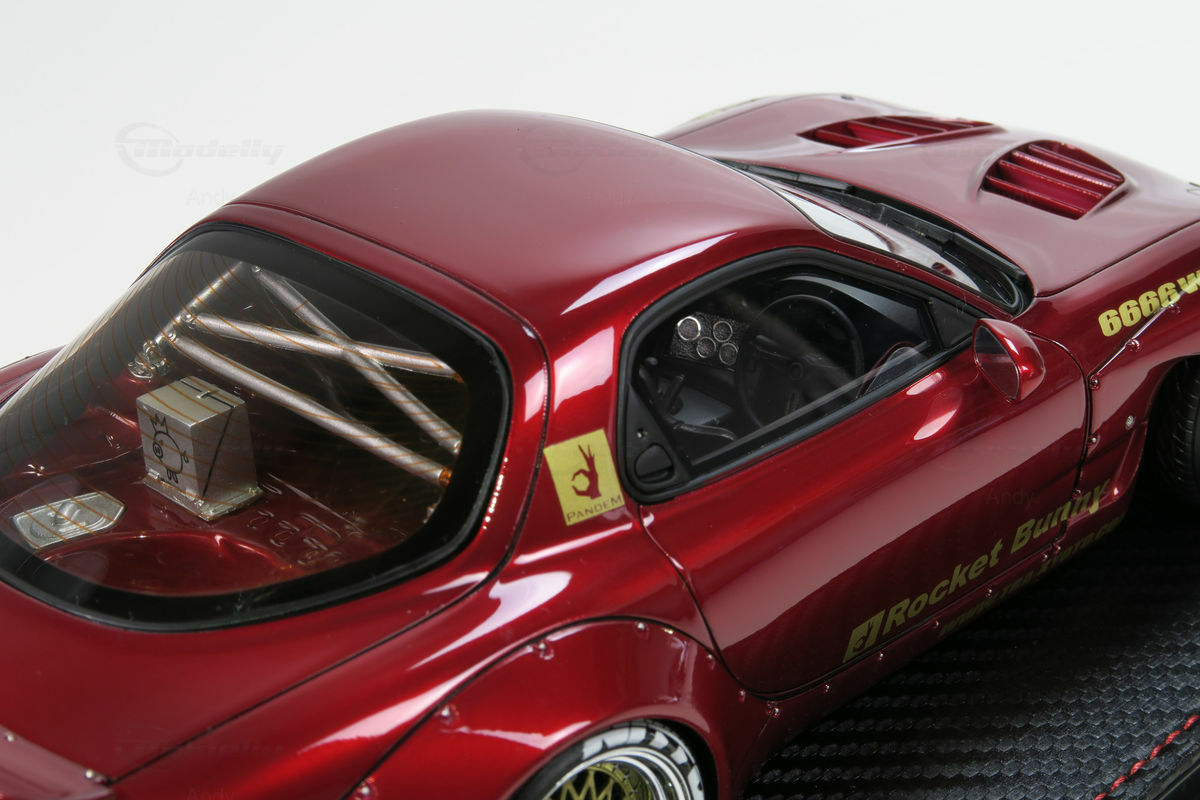
1/18 resin model car by Ignition Models in dark red
This model car in 1/18 scale was made by Ignition Models and is based on the modified Mazda RX-7 (FD3S). The miniature is made of resin. That material makes it possible to capture tiny body lines, wide add-on parts, and separate rows of rivets; on this example, the wheels are typically not steerable and the hood or doors don’t open. It is a limited edition, which is pretty typical for resin collector models from this maker. The paint is a deep metallic dark red with highly reflective surfaces. Black sections create contrast on the front lip, rear diffuser, window trim, and taillights. The rear wing has a gold Rocket Bunny script on top. More gold graphics include the logo on the rear side window, the large script on the side skirts, and the “HASHIMOTO corporation” lettering on the rear end plates. Up front, you can spot the hood vents, rivets on the fender flares, a black front grille, and a small license plate detail. The mix of dark red bodywork, gold graphics, gold wheel centers, and polished wheel lips gives the model a really bold, high-contrast look.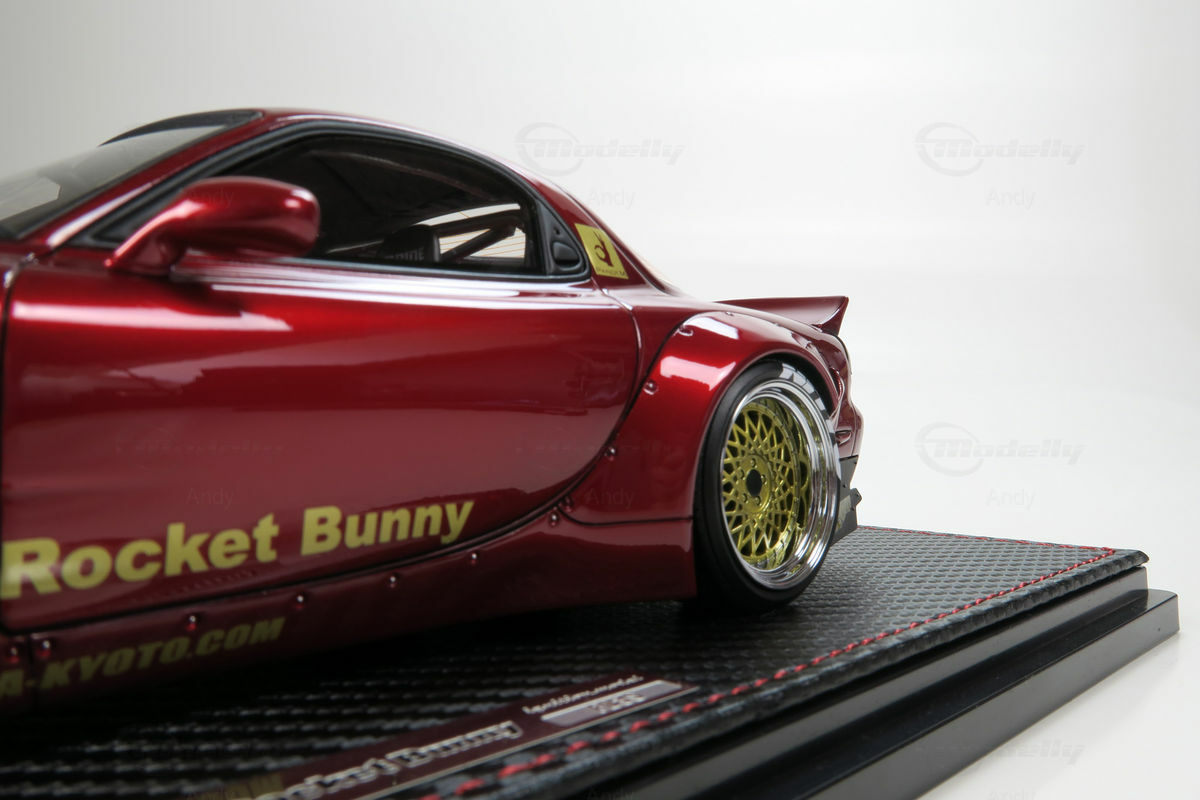
Collector details of Andy’s Mazda RX-7 FD3S on Modelly
The rear view also shows off the finish of the model from Andy’s collection: the tinted taillight unit has clearly defined light segments, and an RX-7 emblem sits in the middle. Under the bumper you can see a central exhaust tip area, black aero pieces, and the gray-black end plates with gold lettering. The wide rear fenders are separated from the stock body by a row of modeled fasteners running around the edge. Inside, there are bucket seats with visible BRIDE branding, an area with a roll cage, and other dark cockpit details. The model sits on a black presentation base with a carbon-fiber texture, red stitching, and a maker plaque. So yes, this 1/18 scale model car from Ignition Models combines the basic shape of the Mazda RX-7 (FD3S) with the clearly visible Rocket Bunny body kit. Its visual impact comes mainly from the low profile, the wide wheels, the dramatic rear wing shape, and the carefully separated paint, graphics, and add-on parts.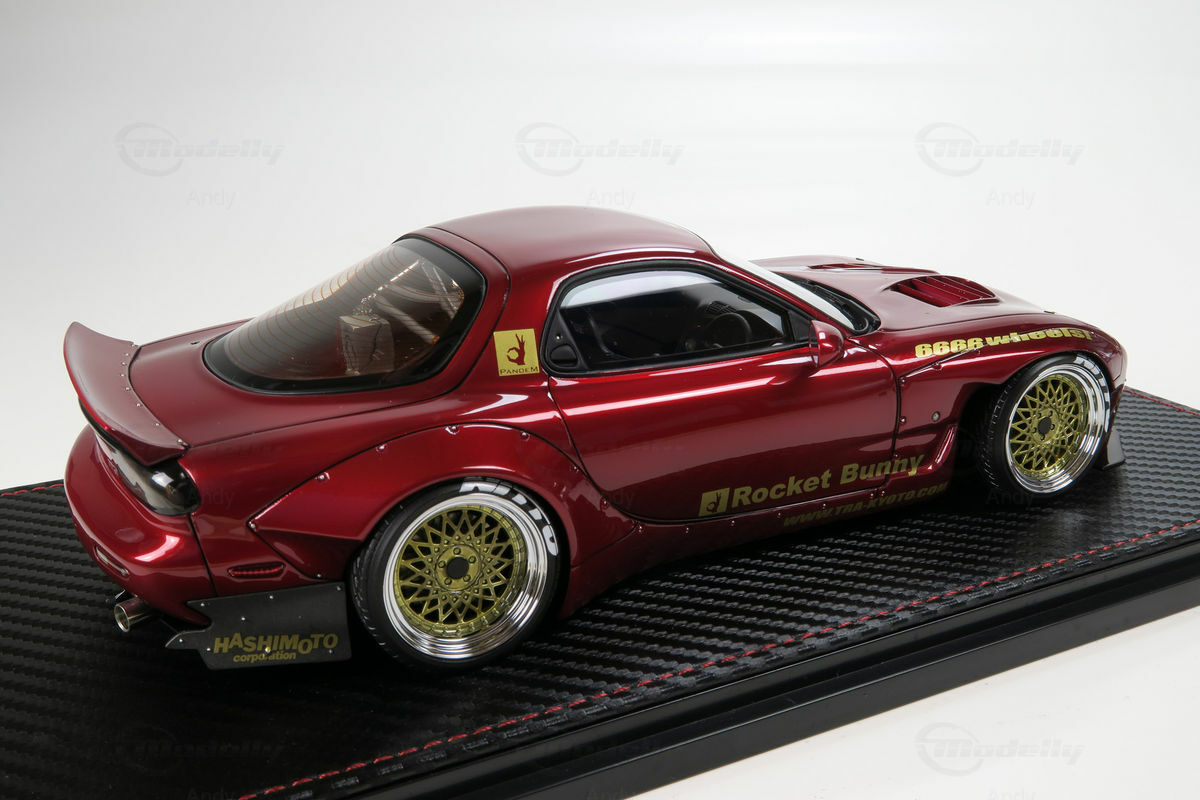
Role model and time context: the Mazda RX‑7 FD3S as a technical reference
The miniature here is based on the Mazda RX‑7 FD3S, the third and final generation of the RX‑7 lineup. This generation — third generation (FD3S) — was built from 1991–2002. The FD3S is a two‑door coupe with front‑mid engine layout and rear‑wheel drive. Its heart is the 1.3‑liter 13B‑REW Wankel engine (1.3 liters (0.34 US gallons)) with sequential twin‑turbocharging; in Japan it was quoted at up to around 206 kW (280 PS). In Europe and North America the published figures varied by year, typically between about 176 and 202 kW. The FD3S was designed to be lightweight—well under 1.3 tonnes (2,866 pounds)—which helped steering precision and a near 50:50 weight distribution. The chassis used double wishbones all around, there were factory limited‑slip differentials, a 5‑speed manual (with a 4‑speed auto offered in some markets), and ventilated disc brakes. Important chassis development is often credited to Mazda engineer Takao Kijima. Compared with the FC3S, the FD3S stepped up aerodynamics, rigidity, and thermal management, including improved intercooling and a more finely tuned sequential turbo control. For a quick time reference: 1991 saw the end of the Soviet Union, the Gulf War was in the news, and Nirvana released “Nevermind.” Those are just context markers to place the FD3S historically.
Tuning reference: Rocket Bunny, TRA Kyoto and typical mods
The model shown features a Rocket Bunny style fitment. Rocket Bunny is the brand of the Japanese company TRA Kyoto, founded in the mid‑1990s (often cited as 1995) by designer Kei Miura. Their signature widebody kits use bolt‑on or riveted fender flares, front splitters, side skirts, rear diffusers and wings to give cars a much wider stance. On the model you can see classic cues: heavily flared front and rear overfenders, a fixed rear wing with the Rocket Bunny logo, and extra aero bits on the rear with sponsor stickers — the photos even show “HASHIMOTO corporation.” Real‑world RX‑7 FD3S builds like this often add larger intercoolers, revised exhausts, stiffer dampers/springs and lightweight composite kit parts. The FD3S’s compact Wankel engine and low front axle load make it a great base for these mods, which is why it’s so popular in Japan’s tuning and drift scene.
The collectible: 1/18 scale Ignition Models piece owned by Andy
This is a 1/18 scale model from Ignition Models in Andy’s collection. It’s made from resin, which lets the maker do really sharp edges and thin aero parts—perfect for the tiny splitters and riveted flares. The model is a limited release, which is something collectors care about. The paint is a dark metallic red with a nice pearl effect. You can see the clear separation of finishes: glossy body, black trim, visible rivets on the overfenders, smoked taillights and crisp decals like the Rocket Bunny logo on the wing and “6666” on the front fenders (a nod to TRA Kyoto’s sister label). The hood has noticeable vents, the front lip sits low, and the wide fenders dominate the side profile. The wheels are deep‑dish mesh with gold centers and polished lips; they fit tightly in the widened arches and the rear shows visible negative camber. Inside, there are bucket seats with side branding and suggested harnesses plus a nicely detailed dash. At the back you get the “RX‑7” badge, a central diffuser and twin exit exhausts. Proportions, gaps and the fine moulding of add‑ons give a faithful feel of the real FD3S. The 1/18 Ignition Models resin run is limited, which makes it easy for collectors to place it in a collection and compare with other limited editions.
Details for collectors: specs, history and search tips
If you want the tech basics: the 13B‑REW uses two turbos of different sizes running sequentially—small one first at low revs, then the system brings the second online at mid‑range. That setup helps reduce turbo lag and smooth out power delivery. Stock top speed was about 250 km/h (155 mph), and 0–100 km/h (0–62 mph) times were, depending on market and year, generally well under six seconds. The FD3S was produced in several series (S6, S7, S8) and in some markets the model was withdrawn in the mid‑90s due to tightening emissions rules, while Japan kept production going until 2002. The Rocket Bunny/TRA Kyoto kits come from Japan and are known for being CAD‑measured and quite dramatic in looks. The Ignition Models miniature reproduces those items: front splitter, big side skirts, riveted fenders and a wing with bold branding. You can also spot sponsor decals like “HASHIMOTO corporation” and a carbon look on the display base. Useful search terms if you want similar models: “RX‑7 FD3S Rocket Bunny,” “resin model car,” “Wankel 13B‑REW,” and “JDM widebody.” This particular release doesn’t seem to reference a specific movie car — it’s more of a general tuned interpretation of the Mazda RX‑7 FD3S. Since Andy’s piece is a 1/18 Ignition Models resin limited edition, it’s easy to catalog for collectors and compare against other limited runs.
- Write a first comment about this model now!Any comment can be discussed by all members. It's like a chat.Mention other Modelly members by using @ in your message. They will then be informed automatically.
- Load 1 posts from archive
- Write a first comment about this model now!Any comment can be discussed by all members. It's like a chat.Mention other Modelly members by using @ in your message. They will then be informed automatically.
- Load 1 posts from archive