
Mercedes-Benz 300 SLR (W 198) Mille Miglia 1955(diecast 1:18, CMC)

- Mercedes-Benz 300 SLR (W 198) Mille Miglia 1955 (from 1955)
- CMC
- 1:18
- Showcase model / No engine
- diecast
- silver
- Perfect mint condition
- Original packaging does not exist
- Not for sale

Historical background on the Mercedes sports car from 1955
The Mercedes-Benz 300 SLR was the sports car Mercedes-Benz used in the 1955 World Sportscar Championship. Internally the open-race version carried the designation W196S and belongs to the W196S family. This generation was built starting in 1955. Technically the Mercedes-Benz 300 SLR was derived from the Grand Prix car W196, but for sports-car rules it got an enlarged inline-eight engine of almost 3.0 liters (183.1 cu in). Rudolf Uhlenhaut was the engineering lead, Hans Scherenberg pushed the powertrain side, and Alfred Neubauer ran the race organization. Its predecessor in customer racing was the 300 SL (W194) from 1952, whose tubular-frame approach laid the groundwork for the later design. The Mercedes-Benz 300 SLR was a track-focused concept: a lightweight tubular spaceframe, body panels in a magnesium alloy (Elektron), mechanical fuel injection, desmodromic valve control and large internal-drum brakes.

The CMC model in Jiten’s collection
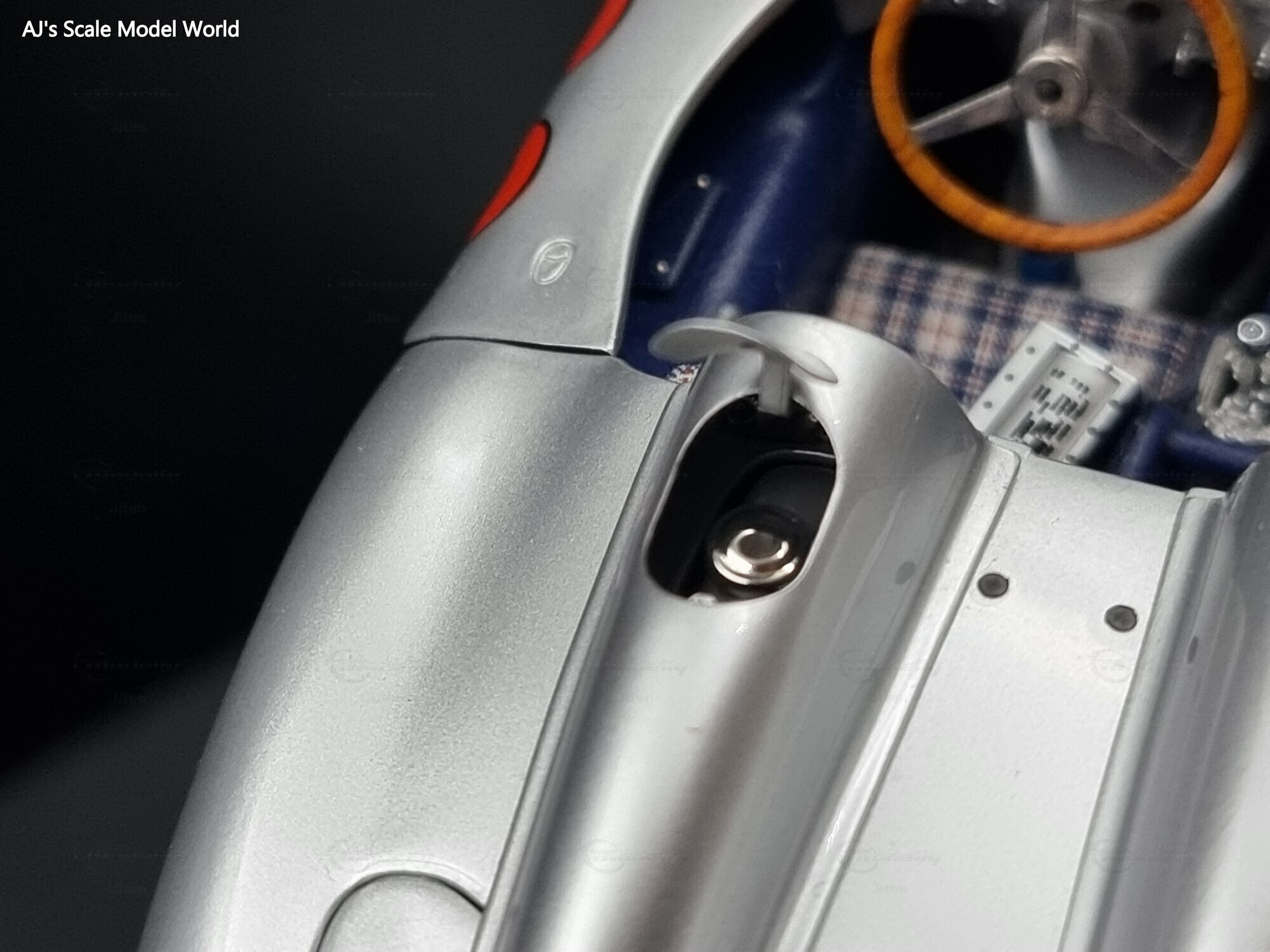
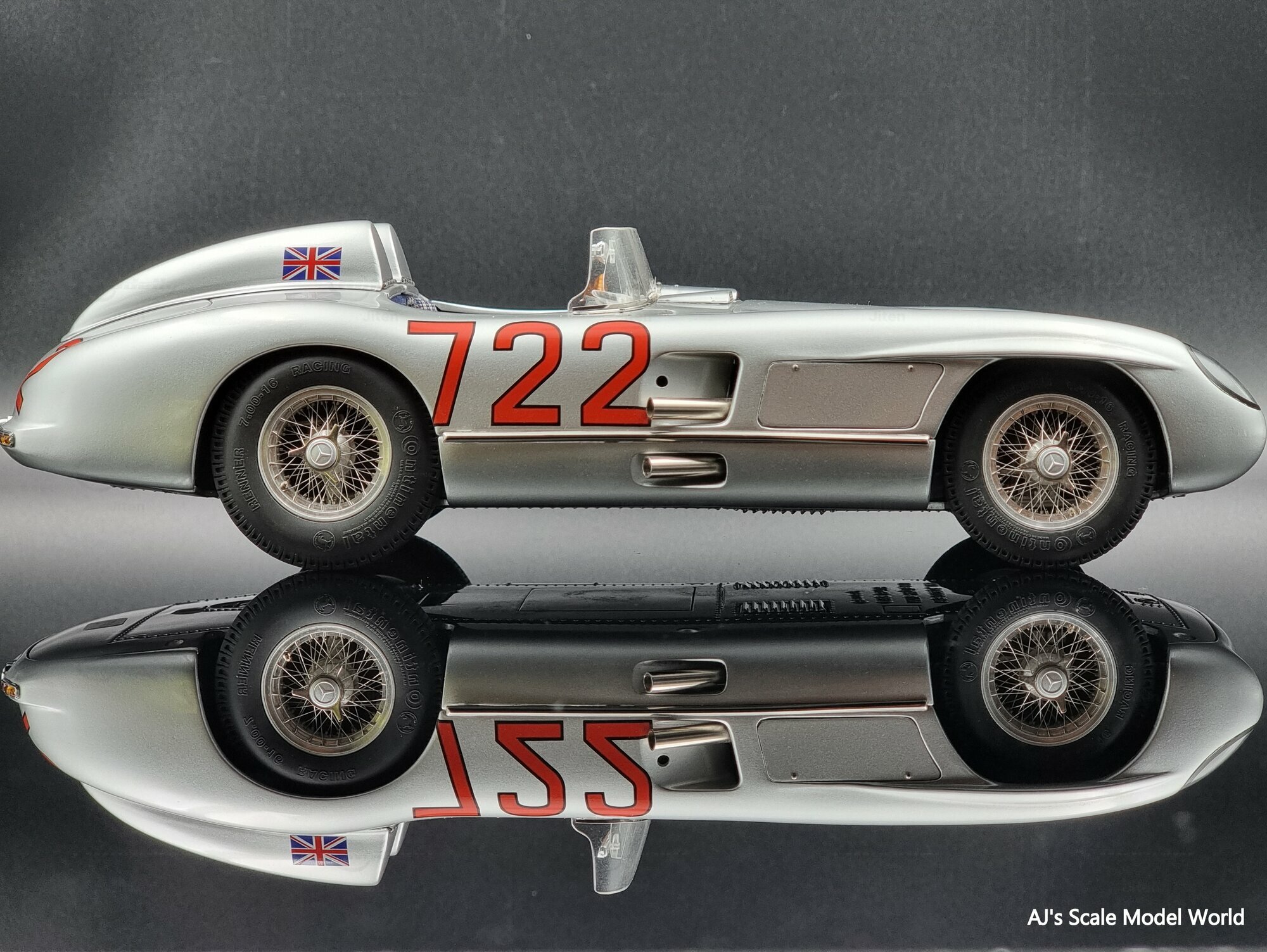
The photos show a model car at scale 1/18 made by CMC, part of collector Jiten’s stash. It’s a diecast model, so it’s metal and has a satisfying weight and solid feel. The model is based on the Mille Miglia entry with start number 722. You can see lots of neat details: fine wire-spoke wheels with a central knock-off, the characteristic side-exit exhaust, the small windscreen in front of the cockpit and the twin headrest fairing. The seat cover shows a checked pattern — that matches period photos where drivers used grippy surfaces for long road races. The red “722” numbers are cleanly applied on the hood, flanks and tail. There’s a small British flag on the side, pointing to the crew. The radiator opening, recessed headlights and the maintenance flaps on the right flank are nicely done. This CMC 1/18 diecast reproduces many of the authentic details collectors like.
Mille Miglia 1955: start number 722 and what it means
The Mercedes-Benz 300 SLR made its most famous run at the Mille Miglia 1955. The car shown here was driven by Stirling Moss with co-driver Denis Jenkinson. The start number 722 actually indicates the 7:22 a.m. start time from Brescia. The pair won the 1,597 kilometers (992.3 miles) road race in 10 hours, 7 minutes and 48 seconds — an average speed of 157.65 km/h (98.0 mph), which was insane for public roads back then. The Mercedes-Benz 300 SLR wore the classic silver “Silver Arrows” paint. The model captures that matte-silver look, with subtle trim lines over the rear bulges. The small windscreen, the narrow passenger seat with harnesses and the leather straps/quick-release fasteners on the hood are all functional touches that show through on the model. The side vent behind the front wheel — used to dump heat — is also well reproduced.

Other races and famous drivers
The Mercedes-Benz 300 SLR also won the Tourist Trophy at Dundrod in 1955 with Stirling Moss and John Fitch, and the Targa Florio with Stirling Moss and Peter Collins. That helped Mercedes take the sports-car world championship. At the 1955 24 Hours of Le Mans the team ran several cars, including entries with Juan Manuel Fangio, Pierre Levegh and John Fitch. After the tragic crash involving Pierre Levegh, Mercedes withdrew its remaining cars; the 300 SLR had been running near the front. Other drivers that season included Karl Kling and Hans Herrmann. The works cars didn’t carry commercial sponsor logos, which is why you’ll notice the clean, sparse liveries on both the real cars and the model.
Technology, looks and how the model captures it
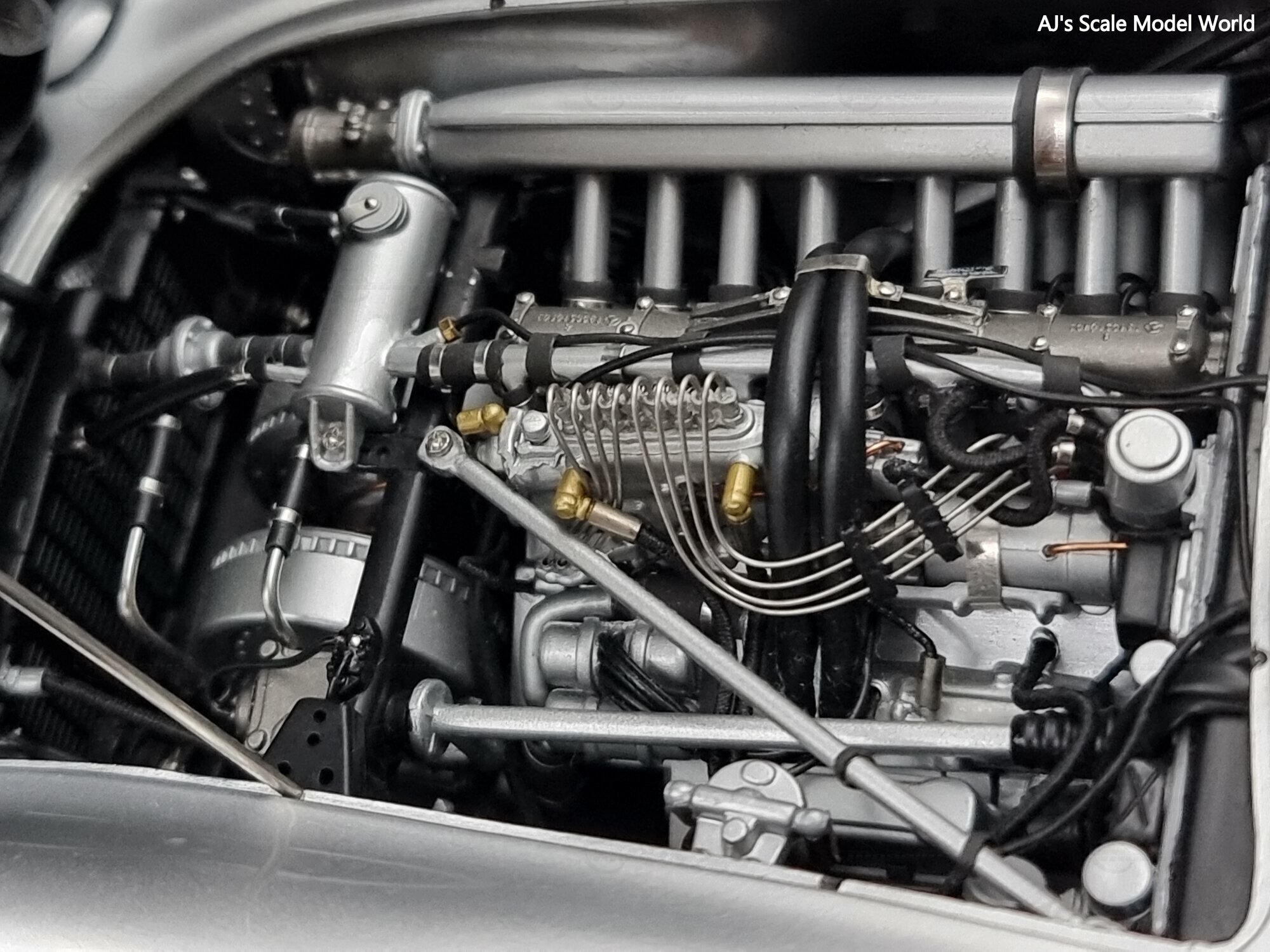
The Mercedes-Benz 300 SLR engine was based on the M196 inline-eight with mechanical fuel injection. For the sports-car version the displacement was enlarged to 2982 cm³ (182.0 cu in). It put out about 228 kW (around 310 PS, ~306 hp) at roughly 7,400 rpm. The engine was tilted slightly in the chassis to allow for a lower body profile; lubrication was handled by a dry-sump system with an external oil tank. The frame was made from thin-walled steel tubes in a spaceframe layout, the body from a magnesium alloy. Paired with independent front suspension, a De Dion rear axle and big internal drum brakes, the race-ready curb weight was about 860 kilograms (1,896 pounds). Top speeds on long straights were in excess of 280 km/h (over 174.0 mph), depending on gearing. Visually, the car is defined by smooth silver surfaces, slim headlight openings and long rear haunches. The model in the photos shows those things clearly: the silver paint without sponsor logos, round lights, the central grille and the dual exhaust on the passenger side. You can even spot hood fasteners and bolt heads along the edges. For collectors, the diecast build gives a sturdy feel while the thin spokes and small details keep it delicate-looking. Overall, this mini captures the Mille Miglia 1955 race trim very well — a nice display piece for Jiten’s collection.


- Write a first comment about this model now!Any comment can be discussed by all members. It's like a chat.Mention other Modelly members by using @ in your message. They will then be informed automatically.
- Write a first comment about this model now!Any comment can be discussed by all members. It's like a chat.Mention other Modelly members by using @ in your message. They will then be informed automatically.